Somewhere around the third week of a Genesis study, someone always asks it. Maybe they saw a documentary with dramatic music and a narrator saying the Bible's first books were "cobbled together centuries later." Maybe they noticed the heading in their study Bible: "The Pentateuch (traditionally ascribed to Moses)." That little word traditionally does a lot of quiet work, and it lands with a thud. If Moses did not write these books, who did? And if nobody knows, what else does nobody know?
It is a fair question, and it deserves a better answer than either a shrug or a shout. The honest answer has three parts: what the Bible itself claims, what the text itself looks like up close, and what actually hangs in the balance for faith. Those three things are not the same, and confusing them is how good people end up either defending more than Scripture asks them to defend or surrendering more than the evidence requires.
What the Torah Says About Its Own Writing
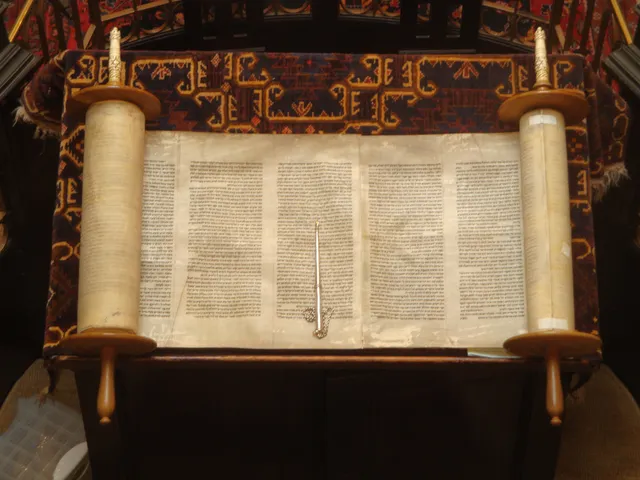
Start with the obvious thing that often gets skipped: the first five books do not present themselves as anonymous. They repeatedly describe Moses writing. After the battle with Amalek, the Lord tells him, "Write this on a scroll as something to be remembered" (Exodus 17:14). At Sinai, "Moses then wrote down everything the Lord had said" (Exodus 24:4). He is told again, "Write down these words" (Exodus 34:27). Numbers notes that "Moses recorded the stages in their journey" (Numbers 33:2). Deuteronomy says plainly that "Moses wrote down this law and gave it to the Levitical priests" (Deuteronomy 31:9), and that the completed scroll was placed beside the ark as a witness.
What those verses claim, strictly read, is that Moses wrote specific material: laws, covenant words, an itinerary, a Song of Songs. They do not say "Moses sat down and composed Genesis through Deuteronomy as we now have them." But the rest of the Bible takes the connection much further. Joshua is told to obey "the Book of the Law of Moses" (Joshua 8:31). Josiah's reformers find "the Book of the Law" in the temple and tear their clothes (2 Kings 22). Ezra reads from "the Book of the Law of Moses" to a weeping crowd (Nehemiah 8:1). By the time of the New Testament, the whole first section of the Hebrew Bible is simply called Moses. Jesus refers to "the Book of Moses" when arguing about resurrection (Mark 12:26), and after the resurrection he explains to the disciples everything written about him "in the Law of Moses, the Prophets and the Psalms" (Luke 24:44).
So the traditional view is not a late church invention imposed on the text. It is the settled assumption of the entire biblical canon, Jewish tradition, and the Christian church for roughly two thousand years. Any alternative account has to explain not only the books but also the universal ancient conviction about who stood behind them.
The Problem Everyone Notices First
And yet. Open to Deuteronomy 34 and read the account of Moses climbing Mount Nebo, seeing the land he would not enter, and dying there in Moab. "He buried him in Moab, in the valley opposite Beth Peor, but to this day no one knows where his grave is" (Deuteronomy 34:6). Then: "Since then, no prophet has risen in Israel like Moses" (Deuteronomy 34:10).
A man can write many things, but not his own obituary, and certainly not the line about how no one has matched him in all the generations since. The rabbis noticed this long before modern criticism existed. The Talmud preserves a debate: one view holds that Joshua wrote the final eight verses, another that Moses wrote them in tears at God's dictation. The fact that ancient believers argued about it tells us something useful. Taking the question seriously is not a modern loss of nerve; it is an old form of careful reading.
Once you start looking, there are other seams. Genesis 12:6 mentions that "at that time the Canaanites were in the land," a remark that makes most sense written by someone for whom they no longer were. Genesis 36:31 lists Edomite kings "before any Israelite king reigned," a backward glance from the monarchy. Abraham pursues raiders as far as Dan (Genesis 14:14), though Judges 18 tells us the city got that name generations after Moses. Numbers 12:3 calls Moses "more humble than anyone else on the face of the earth," which is a strange sentence to write about yourself. None of these is a scandal. They look like the ordinary marks of a text that was transmitted, updated, and lovingly kept current by scribes who wanted later readers to know where the places were.
Where the Documentary Hypothesis Came From
In the eighteenth century, a French physician named Jean Astruc noticed something that attentive readers had long felt without naming: Genesis alternates between calling God Elohim and YHWH, and the alternation seems to track with differences in style and emphasis. He suggested Moses had used earlier sources. Over the next century and a half, that modest observation grew into an elaborate reconstruction, reaching its most famous form in the work of Julius Wellhausen in the 1870s.
The resulting theory, usually abbreviated JEDP, proposed four main strands woven together by later editors: a Yahwist source (J), an Elohist (E), the Deuteronomist (D) responsible for Deuteronomy and Josiah's reform, and a Priestly source (P) supplying genealogies, ritual law, and the ordered creation account of Genesis 1. The evidence offered was real textual data: the divine names, apparent doublets (two creation accounts, two covenant ceremonies with Abraham, Sarah and Rebekah both passed off as sisters), differing legal details about altars and festivals and slavery, and shifts in vocabulary.
What is less often mentioned is the framework Wellhausen brought to that data. He assumed religion develops from simple to complex, from free local worship toward centralized priestly ritual. So the priestly material had to be late, and Israel's law had to be largely a post-exilic invention projected back onto a half-legendary founder. The theory did not merely rearrange the Torah; it rewrote Israel's history, making the prophets earlier than the law and the covenant at Sinai a retrojection.
Why the Picture Has Shifted
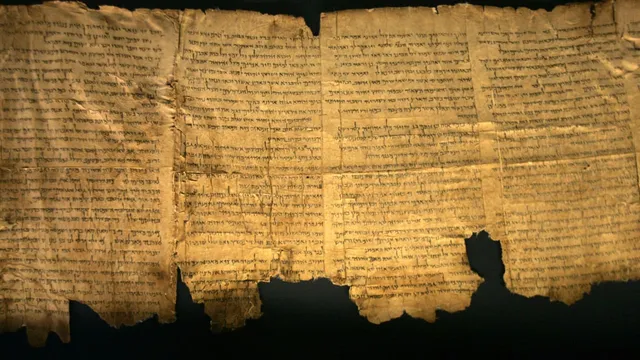
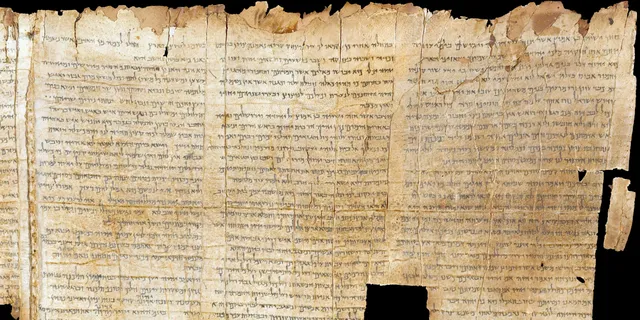
Here is a fact that rarely makes the documentaries: there is no manuscript anywhere of J, E, D, or P. Not a fragment. Every copy we possess, including the Dead Sea Scrolls, contains the Torah essentially as we have it. The sources are reconstructions from the finished text, which means the argument is circular in a way its critics have long pointed out.
More telling, the consensus itself has come apart from the inside. Over the last fifty years, specialists in the field have fractured. Some abandoned E entirely. Some replaced documents with supplements, a core text successively expanded. Some moved everything much later, into the Persian or even Greek period; others pushed major portions earlier. Scholars also discovered that ancient Near Eastern literature regularly uses divine-name variation, repetition, and parallel accounts as deliberate literary technique rather than as evidence of stitching. Two creation accounts are not necessarily two sources. They may be a wide-angle lens followed by a close-up, which is exactly how Genesis 1 and Genesis 2 function.
Meanwhile, other evidence has quietly favored antiquity. Deuteronomy's structure closely mirrors second-millennium Hittite treaty forms (preamble, history, stipulations, witnesses, blessings and curses), a pattern that had fallen out of use by the time Wellhausen would place the book. Alphabetic writing existed in the Sinai region in the Late Bronze Age, so a literate man raised in Pharaoh's household could certainly have written. The question is still genuinely debated, but the confident nineteenth-century certainty that the Torah is a late fabrication no longer stands where it once did.
A View That Holds Together
Many thoughtful Christians, including conservative scholars, hold a position sometimes called essential Mosaic authorship: the substance of the Torah comes from Moses, including the laws, the covenant documents, and the narrative framework, while the books as we have them show the hand of later inspired editors who updated place names, smoothed language, added the account of Moses' death, and arranged the material into its final form.
This is not a compromise invented to escape criticism. It is how the Bible handles authorship elsewhere. Proverbs says openly that chapters 25 and following are "more Proverbs of Solomon, compiled by the men of Hezekiah king of Judah" (Proverbs 25:1), two centuries after Solomon. The Psalms are David's in substance and compiled into five books by editors long after him. Jeremiah dictated to Baruch, who wrote the scroll (Jeremiah 36:4). Scripture simply does not share our modern anxiety about a single named author producing an untouched manuscript.
If God could inspire Moses to write, he could inspire Joshua or a later scribe to record Moses' death and preserve the whole for Israel. Inspiration attaches to the text God gave his people, not to our ability to name every hand that held the pen.
But Didn't Jesus Settle It?
This is the piece that matters most to many believers, and it should not be waved away. In John 5:46 Jesus says, "If you believed Moses, you would believe me, for he wrote about me." That is not a casual citation; it is an argument that leans on Moses as a real author bearing witness.
Some argue Jesus was simply using the customary name for a body of literature, the way we say someone "read Shakespeare" without ruling out collaborators. Others answer that Jesus' authority means his attributions are reliable in whatever sense he intended them. Both points have force, and taken together they lead somewhere sensible. Jesus treats the Torah as truthful, authoritative, Mosaic in origin, and pointing to himself. He was not weighing in on whether a scribe later wrote the words "to this day" into Deuteronomy. Honoring his testimony means honoring what he actually asserted, with all the weight he gave it, and no more.
What Is Actually at Stake
Here is where clarity helps. A great deal of Scripture is anonymous. We do not know who wrote Judges, Kings, Job, Esther, or Hebrews, and no Christian doctrine wobbles because of it. If you learned tomorrow that Deuteronomy's final form came from a faithful scribe in Jerusalem, the gospel would be exactly where you left it.
But something real is at stake in the stronger version of the critical theory. If the law was invented after the exile and attached to a founder who may never have existed, then the Exodus did not happen, the covenant at Sinai is a later community's self-justification, and the God who says "I am the Lord your God, who brought you out of Egypt" is speaking about an event that never occurred. The Bible stakes everything on God acting inside real history, not on inspiring beautiful stories about it. Paul rests the resurrection on witnesses, and Israel rests its whole identity on a rescue it claims to remember.
So defend the right thing. The fight is not over whether a later editor tidied a place name. It is over whether God spoke and acted in the wilderness, and whether the words Israel carried beside the ark are the words he gave.
Reading It the Way Jesus Read It
There is a practice worth taking from all of this, and it is simpler than the debate. The next time you open Genesis or Deuteronomy, read a chapter asking the question Jesus asked of it: where is this pointing? He walked two disciples through Moses and the Prophets on the Emmaus road and left their hearts burning, and he did it without once discussing sources.
That does not mean the historical questions are unimportant. Ask them. Read widely, learn the arguments, and let the seams in the text teach you something about how patiently God worked through generations of scribes and shepherds and prophets to deliver his Word. A faith that can hold a hard question without flinching is sturdier than one that has never been asked.
But do not let the question of the pen displace the question of the voice. The Torah's own claim is not finally about authorship. It is that a God who makes and keeps promises spoke to a stammering shepherd on a mountain, bound himself to a freed people, and wrote his instruction down so it would not be lost. Thirty-five centuries later, you are holding it.