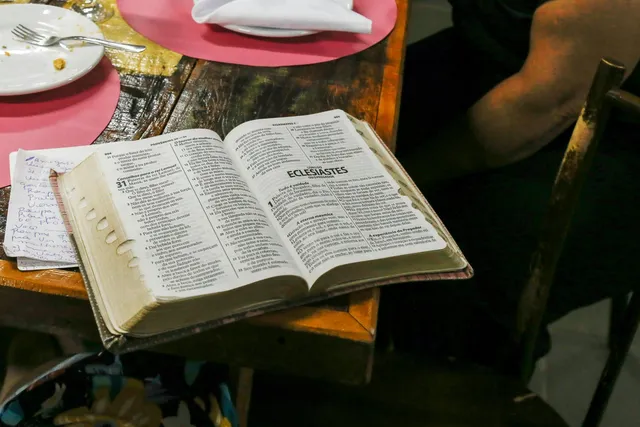
Every believer who spends time in Scripture long enough will eventually stumble into a moment of puzzlement. One passage seems to say this, another seems to say that-and before we know it, we're staring at our Bible with furrowed brows asking, "Wait... which is it?" For some, these apparent contradictions spark doubt. For others, they open the door to deeper faith and discovery. The truth is, how we handle the seeming inconsistencies in Scripture reveals a lot about our approach to God Himself.
When the Tension Is the Teacher
The Bible is not a tidy set of propositions-it is a living story, breathed by the Spirit, written through real people across centuries. It contains poetry and prophecy, wisdom and history, lament and love letters. We shouldn't expect a book like that to flatten neatly into bullet points. The Bible's tension is intentional-it drives us back to God, the one who holds truth in perfect harmony even when we cannot see it clearly.
Jesus Himself could seem contradictory at times. He proclaimed, "My yoke is easy, and my burden is light" (Matthew 11:30), yet He also said, "Whoever wants to be my disciple must deny themselves and take up their cross daily" (Luke 9:23). Easy and daily cross-bearing-how can both be true? Only when we live in Him do we find that His cross-bearing becomes our freedom, His burden our rest. The tension reveals a deeper truth, not confusion.
Apparent Contradictions or Complementary Truths?
Many times what are labeled as contradictions are simply instances of Scripture looking at the same reality from two different perspectives. Like light passing through stained glass-it's one light, but different colors emerge depending on which window you look through.
The Gospels as a Case Study
Take the four Gospels, for instance. One tells of two angels at the tomb, another of one. One records Jesus healing two blind men, another only one. Are the writers clashing? Not necessarily. Each was bearing witness from a particular vantage point-to a particular audience-with a particular purpose. The Spirit didn't erase their humanity; He inspired through it.
In our modern minds, we often equate truth with sameness. But biblical truth often comes through the richness of multiple witnesses. Just as every person's encounter with Christ is uniquely colored by their story, so too each Gospel writer colored his account through his own redeemed perspective. Rather than contradiction, we find completion.
Understanding the Ancient World of the Text
We also must remember that the Bible was not written in twenty-first-century English. Its authors were immersed in ancient Hebrew, Aramaic, and Greek cultures-each with idioms, literary styles, and patterns of thought different from our own. What seems like an inconsistency may simply reflect a different way of expressing truth.
For example, Hebrew writers often used parallelism-repeating ideas for emphasis rather than exact chronology. Genesis 1 and 2 tell the story of creation, not as contradictory versions, but as two lenses: one cosmic, one intimate. The first declares the grandeur of God's creative power; the second whispers His closeness as He forms humanity from the dust. When we expect perfect Western-style sequencing, we risk missing the theological melody playing beneath the words.
Truth Through Relationship, Not Precision Alone
The Bible teaches truth relationally, not just informationally. It's not a technical manual, but a Revelation of God's heart. That means Scripture is true in a deeper way than factual alignment-it's faithfully true. It reliably leads us into right relationship with the Creator. So, when two passages appear to differ, the wise question isn't first, "Who's wrong?" but "What is God teaching me through the difference?"
The God Behind the Pages
At the heart of Scripture's unity is not human harmony but divine authorship. Christians confess that the Bible is God-breathed (2 Timothy 3:16). That doesn't mean God dictated every word in robotic fashion. Rather, He inspired real lives, shaped through real experiences, to tell His one redemptive story. That story culminates not in the absence of contradiction but in the person of Christ-the living Word who holds all the paradoxes of heaven and earth in Himself.
When you look closely, the Bible's "contradictions" reflect that same paradoxical glory. The first shall be last; the meek inherit the earth; losing life is the way to find it. These aren't errors-they are invitations into God's upside-down kingdom.
The Beauty of Divine Paradox
Faith itself lives in paradox. We believe in what we cannot see. We are strongest when weak. We find joy in suffering because it leads to endurance and hope. The contradictions of Scripture often mirror the contradictions within the life of faith itself-and through them, the Spirit forms our humility, patience, and trust.
Job and the Mystery of Suffering
Consider Job. His friends offered polished theology, cause-and-effect reasoning. Job's cries were messy, sometimes conflicting, deeply human. Yet in God's response, we find not correction of every detail but Revelation: God is bigger than Job's-and our-understanding. The apparent contradictions dissolve in the greater presence of the Almighty.
When we treat Scripture as something to conquer rather than be changed by, we end up missing the very God it reveals. Sometimes, the contradictions aren't there to be solved; they're there to make us surrender.
The Role of Faith and Humility
There will always be passages that refuse to tie up neatly. That's not a flaw-it's an invitation to deeper trust. As Paul wrote, "Now we see through a glass, darkly" (1 Corinthians 13:12). We live in the in-between: redeemed but not yet perfected, known by the One we are still learning to know.
When we open the Bible expecting it to always fit our categories, we make ourselves the authority. But when we approach in humility, asking the Spirit to guide us, contradictions become conversation points-not conclusions. God often hides truth in tension to draw us closer. Faith grows not in certainty, but in pursuit.
Living with the Questions
Honest faith doesn't fear the hard questions. The Psalms are full of them: "Why, Lord, do You stand far off?" "How long, O Lord?" The Bible makes room for wrestling-and wrestlers like Jacob end up walking differently because of it. The questions we fear may be the very tool God uses to deepen our dependence on Him.
It's okay to admit that not everything in Scripture is easy to reconcile. But rather than running from the inconsistency, we can rest in the consistency of God's character. The same God who spoke light into the darkness can illuminate our doubts. The same Spirit who hovered over the waters can hover over our confusion. The goal is not to erase every tension, but to let the tensions shape us into people who trust God beyond explanation.
How to Read When You Don't Understand
When faced with apparent contradictions, it helps to slow down. Read prayerfully. Compare translations. Ask what genre you're in-poetry, prophecy, wisdom, gospel. Scripture is always truest in its intended form. Seek the broader story-what does this reveal about God's nature, His plan, His Son?
And never forget, you're not reading alone. The Church through the centuries has wrestled, asked, and found Christ faithful in every era. Conversation with trusted mentors, study groups, and wise scholarship can open new layers of understanding. We are a community of learners, called to explore together, not to judge one another's uncertainties.
Letting the Spirit Interpret
Ultimately, understanding comes not from intellect alone but from the Spirit. Jesus promised that the Spirit would "teach you all things" (John 14:26). That doesn't mean instant clarity, but steady Revelation. As we stay close to Him, contradictions begin to turn into coherence, disorder into devotion. The Word becomes flesh in us all over again.
Harmony Within the Heart
Perhaps Scripture's contradictions aren't obstacles to belief but invitations into awe. They draw us into the mystery of a God whose ways are higher than our own, a God who refuses to fit within our logic but fits perfectly within our longing hearts. As we walk by faith, we learn that truth isn't something to master-it's Someone to follow.
In the end, the greatest harmony we can find in the Bible is the one the Spirit writes inside us. We read not to remove all dissonance, but to let our hearts resound with the music of divine love. So the next time you find a contradiction in those sacred pages, pause and breathe. Perhaps heaven is speaking in stereo-two different notes forming one beautiful chord of grace.