Imagine standing on a rise of ground in the Sinai wilderness at dusk, looking down on a camp of tents spread out in four great blocks. In the exact center of it all is a rectangle of white linen curtains, about the size of a modern basketball court laid out twice over, glowing faintly in the last light. Inside that fence, a plain goat-hair tent. Above it, a pillar of cloud that will burn like fire when the sun goes down. Everyone in that camp, no matter which direction their tent flap faced, opened it toward the same place. That was the point. The God of heaven had moved into the neighborhood, and He pitched His tent in the middle of the street.
Modern readers tend to skim the tabernacle chapters. Exodus spends about fifty verses on the creation of the world and roughly thirteen chapters on the construction of a portable sanctuary, which tells you something about what the book thinks is worth lingering over. If you slow down and walk through it, room by room, the whole structure turns out to be a sermon in fabric, wood, and gold.
Why a Tent at All
The instructions begin with a purpose statement that should stop us: "Let them make me a sanctuary, that I may dwell in their midst" (Exodus 25:8). Not so that Israel could climb up to God, and not so that God could be contained. The verb is the point. He intended to dwell, to settle in, to be near people who had just spent four hundred years learning that gods live in stone temples behind walls and that ordinary laborers do not get invited in.
Everything about the design says both nearness and distance at once. God is close enough to be at the camp's center, and holy enough that you cannot simply wander in. The tabernacle is not a puzzle designed to frustrate us; it is a set of graded spaces that teach an unhurried lesson about who God is and what it costs for sinners to come near Him. It is also, remarkably, a community project. The materials came from freewill offerings until Moses had to tell people to stop giving (Exodus 36:6), and the chief craftsman, Bezalel, is the first person in the Bible described as filled with the Spirit of God (Exodus 31:3). Before the Spirit filled prophets, He filled an artist with skill for making a beautiful place for worship.
The Courtyard: One Gate, One Way In
You approach from the east. The perimeter is a fence of fine white linen hung on bronze-based posts, roughly seven and a half feet high, enclosing a court about 150 feet by 75. There are no windows, no side doors, no service entrance. There is exactly one opening, a screen woven in blue, purple, and scarlet yarn, and it faces the rising sun.
That single entrance is the first thing the tabernacle preaches. Access is real, but it is not on your terms. Later, when Jesus says "I am the door" and "no one comes to the Father except through me" (John 10:9; John 14:6), He is not inventing a narrow idea. He is naming Himself as the gate every Israelite had already walked through for centuries without knowing whose shape it took.
Step through the screen and the first thing that meets you is not beauty. It is blood.
The Bronze Altar
Directly inside the gate stands a hollow acacia-wood box overlaid with bronze, about seven and a half feet square and four and a half feet high, with horns at its four corners and a grate for the fire. This is where the animals died. Lambs morning and evening, day after day, plus the offerings brought by ordinary families for sin, for thanksgiving, for vows kept and broken.
It is impossible to over-stress how unavoidable this altar was. You could not reach the holy place without passing it. The smell of smoke and the sound of the fire were the constant background of Israel's worship. Long before anyone theorized about atonement, Israel learned it with their eyes: coming near to God costs a life, and God provides the substitute. Leviticus 17:11 puts the logic plainly: "it is the blood that makes atonement by the life."
The Bronze Basin
Between the altar and the tent sat a bronze basin of water, cast (Exodus 38:8 tells us) from the mirrors of the women who served at the entrance. Priests washed their hands and feet here before entering the holy place and before approaching the altar, on pain of death. Sacrifice dealt with guilt; the washing dealt with the daily grime of service. Both were required.
Anyone who has ever felt forgiven and still dirty knows the difference these two pieces of furniture mark. Jesus makes the same distinction in the upper room when Peter asks Him to wash his whole body and Jesus answers that the one who has bathed needs only to wash his feet (John 13:10). The altar is once. The basin is daily.
The Holy Place: Bread, Light, and Prayer
Now the tent itself, a structure about forty-five feet long and fifteen wide, made of gold-plated acacia frames and covered with four layers of curtains. From the outside it looked drab, ram skins and durable hides. Inside, everything was gold and embroidered linen with cherubim woven into it. That contrast is worth sitting with. The glory was not on the outside.
Only priests entered here, and only in the first room, the holy place, which held three pieces of furniture.
The Table of the Bread of the Presence
On the north side stood a small gold-covered table holding twelve loaves, arranged in two rows and replaced every Sabbath, with frankincense set alongside. Twelve loaves for twelve tribes. It was the whole nation, symbolically, set on a table in God's house, and the priests ate the old bread each week in a holy place.
This is God keeping His people perpetually before His face, and feeding them from His own table. When Jesus says "I am the bread of life" (John 6:35) to a crowd fixated on manna, He is stepping into a conversation the tabernacle had already started.
The Golden Lampstand
Opposite the table, on the south side, stood the menorah: a single hammered piece of pure gold, its central shaft and six branches shaped like almond blossoms, its seven lamps burning olive oil. There were no windows in the tent. This lamp was the only light in the room, tended by the priests every morning and evening so that it never went out (Exodus 27:20-21).
A living tree of light in a sealed room, fueled by beaten oil, kept burning by faithful daily attention. Israel would later be told they existed to be a light to the nations. Jesus says, "I am the light of the world" (John 8:12), and Revelation shows the churches themselves as lampstands standing before the throne.
The Altar of Incense
At the far end of the room, right against the curtain that hid the innermost chamber, stood a small gold altar where a specially compounded incense burned morning and evening as the lamps were tended. No other incense was permitted. Nothing else was to be offered there.
The meaning is given directly in Scripture: "Let my prayer be counted as incense before you" (Psalms 141:2), and in Revelation 5:8 the golden bowls of incense are "the prayers of the saints." Notice where the altar of incense sits. Prayer is the piece of furniture placed closest to the presence of God, pressed right up against the veil, ascending into a room the priest himself could not enter.
Behind the Veil
The curtain separating the two rooms was blue, purple, and scarlet linen with cherubim embroidered on it, the same guardians who stood at Eden's gate with a flaming sword. That is not decoration. It is a memory. The way back into God's unmediated presence had been closed since Genesis 3, and the veil said so in thread.
Behind it, in a perfect cube of a room about fifteen feet on each side, sat one object: the ark of the covenant. A gold-covered chest containing the two tablets of the law, and later, according to Hebrews 9:4, a jar of manna and Aaron's staff that budded. On top of it lay the mercy seat, a solid gold lid with two cherubim facing each other, wings outstretched, and between them the invisible presence of the Lord who "sits enthroned on the cherubim" (Psalms 80:1).
Consider what that arrangement says. Inside the box, the broken law that condemns. Over the box, a lid of pure gold. On the Day of Atonement, once a year, the high priest carried blood past the veil and sprinkled it on and before that lid (Leviticus 16). The commandments Israel had shattered were still there, but they were covered, and what God saw when He looked down was blood. The Hebrew word for that lid, kapporet, is related to the word for atonement. Paul reaches for exactly this image when he says God put Christ forward as a hilastērion, a mercy seat, by His blood (Romans 3:25).
When the whole thing was finished, Moses could not enter, "for the cloud settled on it, and the glory of the Lord filled the tabernacle" (Exodus 40:34-35). Exodus ends with the architect locked out of his own building by sheer glory.
How John Reads the Tent
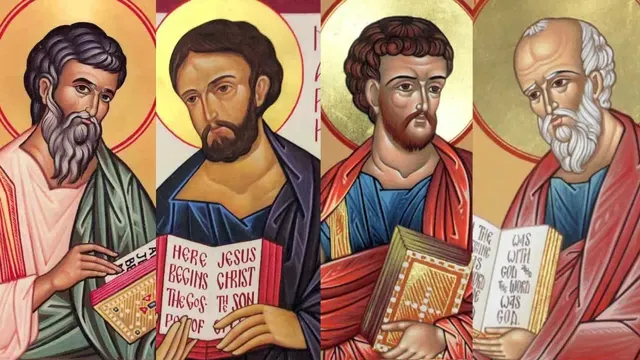
John opens his Gospel with a sentence that most English translations soften: "The Word became flesh and dwelt among us, and we have seen his glory" (John 1:14). The verb behind "dwelt" is eskēnōsen, from the word for tent. He tabernacled among us. John is telling his readers, many of whom knew the Torah by heart, that the cloud and the glory and the tent at the center of the camp have all come to a single address, and that address is a Galilean carpenter.
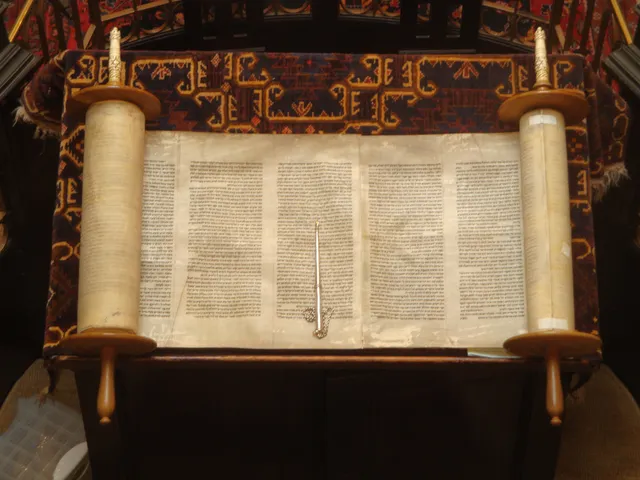
He keeps at it. Jesus speaks of "the temple of his body" (John 2:21). He is the door, the bread, the light. And at the crucifixion John records that no bone of Him was broken, the requirement for the Passover lamb. John's entire Gospel invites you to walk the tabernacle's floor plan and find a person waiting at every station.
How Hebrews Reads the Tent
Hebrews takes the same material and works it out with careful argument. The earthly sanctuary, it says, was "a copy and shadow of the heavenly things" (Hebrews 8:5), a scale model of a greater reality. The Levitical priests stood daily offering sacrifices that could never take away sins, because the very repetition proved the job was unfinished (Hebrews 10:11).
Then Christ appeared as high priest, and "he entered once for all into the holy places, not by means of the blood of goats and calves but by means of his own blood, thus securing an eternal redemption" (Hebrews 9:12). One entrance, one offering, no annual return trip. Which is why the author can write the sentence that would have sounded like blasphemy to any priest who ever served in that tent: "we have confidence to enter the holy places by the blood of Jesus, by the new and living way that he opened for us through the curtain, that is, through his flesh" (Hebrews 10:19-20).
Matthew reports that at the moment Jesus died, the curtain of the temple was torn in two from top to bottom. Not cut, not pulled aside. Torn, and from above.
Living Inside the Blueprint
There is one more turn to make. Having shown that the tent pointed to Christ, the New Testament then says the sanctuary has moved again. Paul tells the Corinthians their bodies are a temple of the Holy Spirit (1 Corinthians 6:19) and tells the Ephesians that the whole church is "being built together into a dwelling place for God by the Spirit" (Ephesians 2:22). The camp with the tent in the middle has become a people with the Spirit inside.
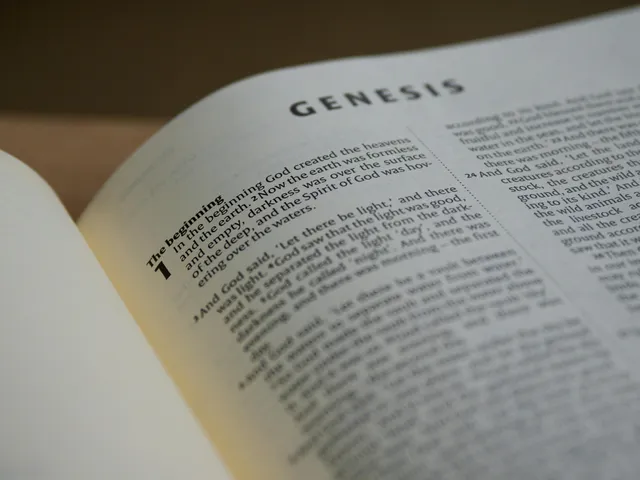
So the next time Exodus 25 through 40 shows up in your reading plan, try not skimming. Read it slowly with a pencil, and read it as a floor plan you are actually walking. Notice how far you get before you meet the altar. Notice that the light is tended twice a day by someone who shows up whether he feels like it or not. Notice that prayer is the furniture nearest the presence. Notice that the room with the most glory in it is the one nobody could see.
And notice where the story is going. The last vision in Scripture is a loud voice from the throne announcing, "Behold, the dwelling place of God is with man" (Revelation 21:3), in a city that is itself a perfect cube, the shape of the most holy place, now large enough for everyone. The tent in the wilderness was never the point; it was God practicing His intentions in miniature until the day He could live with His people without a curtain.