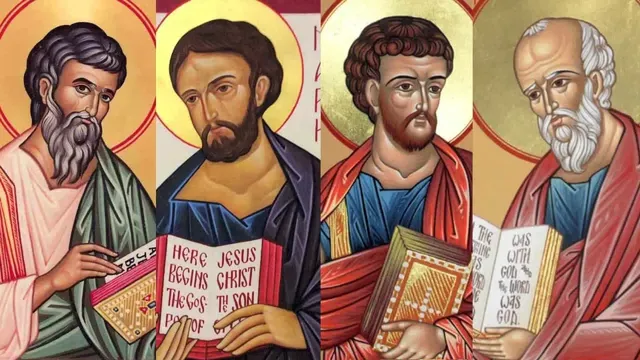
Each Gospel tells the story of Jesus - the same radiant life through four unique voices. Like four musicians in harmony, Matthew, Mark, Luke, and John play distinct notes that together form a single, glorious Song of Songs proclaiming the good news. To read all four is to see the same Savior from different angles: a King, a Servant, a Savior, a Divine Word made flesh. Understanding these perspectives does more than sharpen our theology - it warms our hearts and deepens our walk with Him.
The Gospel According to Matthew: The King and His Kingdom
Matthew's Gospel stands at the doorway between the Old and New Testaments. Written with a Jewish audience in mind, it is soaked in prophecy, genealogy, and fulfillment. From its opening line-"The book of the genealogy of Jesus Christ, the son of David, the son of Abraham" (Matthew 1:1)-we know where we are headed: toward a Messiah who fulfills every ancient expectation.
Matthew's pages are filled with echoes of the Hebrew Scriptures. He quotes Isaiah, Micah, Hosea, Jeremiah-each citation a thread tying Jesus directly to the grand tapestry of God's covenant with His people. His refrain rings again and again: "This was to fulfill what was spoken by the prophet..."
For Matthew, Jesus is the King who brings heaven's kingdom to earth. His Gospel is structured like a royal instruction manual for kingdom living. In the Sermon on the Mount (chapters 5-7), Jesus lays out the ethics of His kingdom-humility, mercy, purity of heart, and love that exceeds what the Law required. Matthew invites us to live as citizens of heaven even while our feet walk dusty roads.
A Gospel of Authority
Throughout Matthew, Jesus teaches "as one who had authority" (Matthew 7:29). He heals by command, forgives sin with divine prerogative, and declares the gates of His kingdom open to all who believe. The final words of this Gospel-known as the Great Commission (Matthew 28:18-20)-reverberate with royal weight: "All authority in heaven and on earth has been given to me." The King sends His people out, not as subjects under fear, but as ambassadors of hope.
Mark: The Gospel of the Servant
Mark's Gospel moves fast-immediately, suddenly, urgently. Its favorite word seems to be "immediately," appearing again and again as Jesus moves from one scene to the next. Mark captures the pulse of ministry in motion: miracles performed amid crowds, teachings shared in passing, lives changed in moments of compassion.
While Matthew presents Jesus as King, Mark shows Him as Servant. There is no birth story here, no genealogies, no extended discourses. Instead, we meet Jesus in action. He comes not to be served, but to serve-and to give His life as a ransom for many (Mark 10:45). Every healing, every word, every step leads toward that ultimate act of service on the cross.
The Humanity of the Servant
Mark doesn't soften the rough edges of human experience. Jesus here is deeply empathetic-He sighs, groans, looks with compassion, grows weary. This raw humanity reminds us that our Lord's service was not detached or theoretical. He entered the grit of real life and gave Himself fully within it.
For modern disciples, Mark's energy stirs a call to active faith. Following Jesus means moving into the world's need with a servant's hands. It means choosing compassion over comfort, mission over maintenance, people over prestige. Mark's Jesus leads the way with dust on His feet and love burning in His heart.
Luke: The Gospel of Compassion and Salvation
If Matthew's portrait gleams with majesty and Mark's with movement, Luke paints in hues of kindness and grace. Written by a physician and careful historian, Luke's Gospel opens the message wider than any before: it is for all people, everywhere. Angels in the Bethlehem night sing not only for Israel but for the world: "good news of great joy... for all the people" (Luke 2:10).
Luke's Jesus is the Savior who seeks the lost and heals the broken. This Gospel alone gives us the parables of the Good Samaritan, the Prodigal Son, and the Lost Sheep-stories where grace overflows boundaries and mercy surprises the listener. In Luke, those on the margins-the poor, the women, the outsiders-find a Savior who calls them by name.
Woven with Prayer and Praise
From beginning to end, Luke's narrative sings with prayer and joy. Before and after each major event, someone is praying or praising: Zechariah in the temple, Mary in her Magnificat, Simeon in the temple courts, Jesus in every season of His mission. In Luke, the human and the divine continually meet in worship.
When Jesus restores the widow's son at Nain, the crowd responds, "God has visited His people" (Luke 7:16). That is precisely Luke's message: God has come near, and His nearness changes everything. Luke teaches us to see God's compassion alive in the very human corners of life.
John: The Gospel of Glory and Intimacy
By the time we reach John, the tone changes completely. Here, the story breathes with wonder. "In the beginning was the Word, and the Word was with God, and the Word was God" (John 1:1). John lifts the veil from Bethlehem and reveals eternity's light breaking into time. If Matthew gives us the King, Mark the Servant, and Luke the Savior, John gives us the Eternal Son-God in the flesh.
John's Gospel contains no parables, no exorcisms, few miracles-but every scene pulses with divine Revelation. Each "sign" (as John calls them) unfolds more of who Jesus truly is: the Bread of Life, the Light of the World, the Good Shepherd, the Resurrection and the Life. Every word aims not just to inform but to awaken faith. As John himself writes, "These are written so that you may believe... and that by believing you may have life in His name" (John 20:31).
The Gospel of Relationship
John focuses on intimacy-between Jesus and the Father, and between Jesus and His followers. Chapters 13-17, often called the Upper Room discourse, overflow with Jesus' final words of love and unity. He washes His disciples' feet, prays for their perseverance, and promises the coming of the Holy Spirit. It is personal, profound, and filled with love beyond measure.
Where the Synoptic Gospels show us what Jesus did, John lingers on who He is. He draws us close to the beating heart of Christ Himself-inviting us to abide in Him as branches in the vine (John 15). That word "abide" becomes a spiritual rhythm: stay, dwell, remain. John's Gospel whispers to every restless believer, "Come and see."
Four Faces, One Lord
In an ancient vision recorded in Ezekiel 1 and echoed in Revelation 4, the prophet sees four living creatures: one like a man, one like a lion, one like an ox, and one like an eagle. Early Christian teachers found in this vision a symbol of the four evangelists:
- Matthew, the lion-roaring with royal authority.
- Mark, the ox-serving in steadfast strength.
- Luke, the man-embodying the human compassion of Christ.
- John, the eagle-soaring high into divine mystery.
Different faces, same radiance. Together they reveal Jesus Christ-not four different Christs, but one Lord seen through four inspired lenses.
When we read them side by side, we begin to perceive a fuller glory. Matthew calls us to obedience under the King's rule. Mark challenges us to serve boldly. Luke invites us to compassion. John draws us into communion. Their harmony teaches us that the life of faith is not one-dimensional but richly textured-royal, humble, merciful, and deeply relational.
Why Four? The Portrait of Wholeness
Some have wondered: why not one authoritative account? Why preserve four? The answer lies not in redundancy but Revelation. Each Gospel writer experienced Christ through the Spirit in a particular way, and together they provide the balanced truth of who He is and how He transforms.
To read Matthew is to be shaped by promise; Mark, by participation; Luke, by empathy; John, by wonder. The Spirit speaks uniquely through each voice so that every kind of heart might hear. For those seeking order and justice, there is Matthew. For those yearning to act and serve, there is Mark. For the gentle and compassionate, there is Luke. For the contemplative who longs for intimacy with God, there is John.
Four Gospels. One Christ. Infinite grace.
Reading the Gospels Devotionally
How might a believer today approach these four divine narratives with new life and depth? Begin by reading slowly, imagining yourself among the disciples as they walk the roads of Galilee, sit at the fireside, listen to His teaching. Let the Gospel you are in shape your prayer. If you are weary from service, rest in John's still waters. If you feel aimless, move with Mark's urgency. If you are burdened by past wounds, marvel with Luke at the compassion that seeks you out. If you crave direction and discipline, listen to Matthew's call to kingdom living.
Consider journaling what each Gospel stirs in you. Ask questions. Pray through Jesus' words. Respond with gratitude. The Spirit who inspired these pages still breathes through them, bringing Christ alive in every generation.
The Living Word for Today
Though the four Gospels were written centuries ago, they continue to speak freshly into every circumstance of human life. They steady us when faith wavers, challenge us when comfort dulls us, and comfort us when sorrow deepens. Like windows in a cathedral, each casts its own colored light upon the same face of Jesus-and together they illuminate the fullness of His glory.
To know the Gospels is to know Jesus-not as a distant figure of history but as the living Lord who still calls, still heals, still loves. In every page we hear His voice again: "Follow Me."
Walking in the Story
The Four Gospels are not just ancient records; they are invitations. They beckon us to live inside the story, to see through the eyes of faith, to walk the same paths of grace. As we read, may we find that the King of Matthew rules our hearts; the Servant of Mark guides our hands; the Savior of Luke softens our vision; and the Word of John fills us with wonder. Four witnesses, one wondrous truth: Jesus Christ is Lord, now and forever.
And so, when we next open our Bibles and turn to those familiar pages, may we do so not out of duty but with expectancy. The Gospels are living waters-four streams that meet in one mighty river of life, flowing straight to the throne of God. Drink deeply, and you will never thirst again.