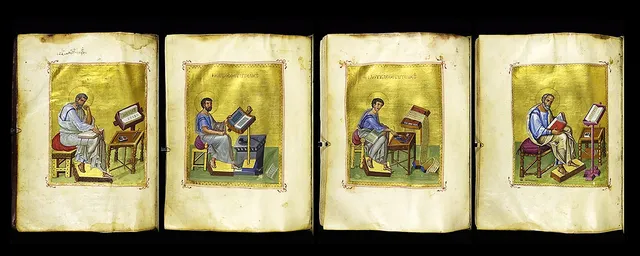
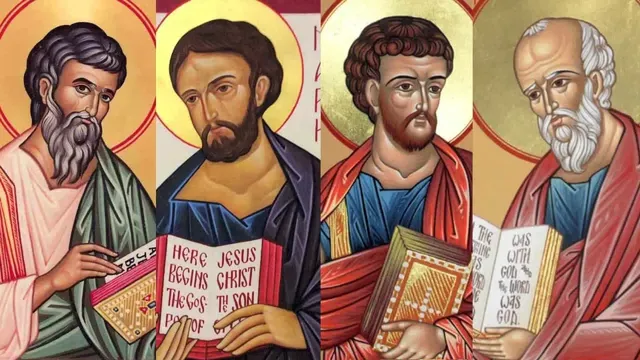
The four Gospels-Matthew, Mark, Luke, and John-stand at the heart of the Christian faith. They are the first books many believers open when they long to meet Jesus afresh. And yet, when read side by side, their differences can feel surprising, even puzzling. One tells of angels at the tomb; another mentions only one. One opens with a genealogy tracing back to Abraham; another soars all the way to eternity, proclaiming, "In the beginning was the Word."
But these differences are not contradictions-they are harmonies. Four distinct voices, four inspired witnesses, describing the same Savior from four divine angles. Their diversity is a strength, not a problem. In reading each Gospel, we encounter a different facet of who Jesus is: King, Servant, Savior, and Son of God. Together, they show us the fullness of the One who changed the world.
Matthew: The King and His Kingdom
Matthew's Gospel feels like a royal announcement. It was written primarily for a Jewish audience, filled with prophecies and fulfillment, roots, and reason. It begins with a genealogy-not random, but royal, tracing Jesus' line through Abraham and David. This is not a mere biographical detail; it's Matthew's way of saying: The King has arrived, just as God promised.
Everything in Matthew orbits around the Kingdom. Jesus speaks more about the "kingdom of heaven" here than anywhere else. The Sermon on the Mount unfolds like the constitution of this heavenly realm, showing what life looks like under the rule of a gracious King. His parables, his miracles, his authority-all point to a new reign breaking into the world's old ruins.
The Genealogies Tell a Story
When we compare Matthew's genealogy to Luke's, we realize they tell slightly different stories. Matthew moves forward from Abraham, showing Jesus' legal right to the throne of David through Joseph. Luke moves backward to Adam, underscoring Jesus' connection to all humanity. Matthew crowns Him the promised Messiah; Luke embraces Him as the Son of Man.
This difference is a reminder: God weaves His plan through every generation, sovereignly writing redemption into real human history. Even the long lists of names-often skipped over-tell us the King doesn't appear out of nowhere. He comes as the fulfillment of centuries of hope.
Mark: The Servant Who Acts
If Matthew's Gospel reads like a coronation, Mark's reads like a race. There's an urgency pulsing through its pages. The word "immediately" appears again and again. Jesus is always moving, healing, teaching, casting out demons, and serving the broken. The pace itself preaches: The Son of God came not to be served but to serve, and to give His life as a ransom for many.
Mark was likely written for believers in Rome-people acquainted with action, power, and suffering. They didn't need long genealogies or prophetic footnotes. They needed to see the Savior who steps into the chaos of human pain and does something about it.
The Gospel of Motion
Notice how Mark omits Jesus' birth story altogether. There are no wise men or shepherds, no Bethlehem night-just the wilderness prophet, John, and then Jesus stepping straight into mission. In Mark's telling, we don't pause for introductions; we plunge into the heart of divine service.
And yet, beneath the flurry of action, there's an undercurrent of compassion. Jesus' miracles are not spectacles; they are mercies. He touches the untouchable. He has time for the forgotten. He sees faith where others see only frailty. Mark's brevity hides deep tenderness.
Luke: The Compassionate Savior
Luke's Gospel feels like an embrace. It is the most expansive in scope, the most careful in detail, and the most intimate in storytelling. Luke was a physician-a man of observation and empathy-and it shows. He speaks to Gentiles as one of them, assuring all readers that salvation is wide enough to include everyone.
Only Luke gives us some of the most beloved scenes in Scripture: the prodigal son returning home, the Good Samaritan stooping to help, Mary pondering in her heart, the thief on the cross hearing the promise of paradise. Luke's Jesus notices the silent sufferer and the outsider at the fringes.
The Gospel of Joy
From the angelic announcement of "good news of great joy" to the disciples worshiping with rejoicing at the end, Luke's narrative sings. Joy and salvation are inseparably linked throughout its pages. The poor, the women, the Gentiles, the children-all find a place at Jesus' table.
And behind it all, Luke reminds us that the Gospel is not just history; it's personal. "That you may know the certainty of the things you have been taught," Luke writes to Theophilus. He invites us, too, to know this certainty-that in Christ, compassion is not abstract but embodied love.
John: The Son Who Reveals the Father
Then comes John, so different from the first three that scholars gave it a special name-the "spiritual Gospel." While Matthew, Mark, and Luke describe what Jesus did, John shows us who Jesus is. He begins before time itself: "In the beginning was the Word, and the Word was with God, and the Word was God." His lens lifts us into eternity. Jesus is not only a teacher or miracle-worker-He is the eternal Word made flesh.
John's language is simple enough for a child to memorize and profound enough to mystify theologians. His Gospel revolves around Revelation-the unveiling of God's heart through the person of Jesus. "Anyone who has seen Me," Jesus says, "has seen the Father."
Signs and Belief
John structures his account around a series of "signs"-water turned to wine, the blind seeing, the dead raised-not to impress, but to invite belief. Each sign points beyond itself, like a window opening toward divine reality. The greatest sign, of course, is the cross, where glory and love meet.
It's in John that we find those deeply personal encounters that linger long after reading: Nicodemus under the night sky, the Samaritan woman at the well, Mary Magdalene at the garden tomb. In each story, we glimpse a Savior who meets people not in crowds but in quiet conversations. John's Jesus knows names, speaks hearts, and calls each by love.
Four Portraits, One Savior
Read together, the four Gospels create a symphony. Matthew's King reigns with just authority; Mark's Servant acts with relentless compassion; Luke's Savior welcomes the outsider; John's Son reveals heaven's heart. Four viewpoints, one great story: God with us.
Sometimes believers feel uneasy about the small variations between the accounts. Why does one Gospel include events another omits? Why are some details ordered differently? Yet these distinctions are exactly what tell us this story is real. The differences are what you hear when four eyewitnesses remember the same miracle from their own angle. They show not confusion, but authenticity-each one painting Jesus with the hues of divine truth and human memory.
And there's more. The four Gospels form a visual cross themselves: stretching out in four directions but centered on one person. The early church fathers even imagined them as living creatures surrounding the throne-man, lion, ox, and eagle-each lifting up the glory of Christ from a different vantage point. Together they teach us that no single perspective can contain the fullness of the Son of God.
When the Gospels Intersect Our Lives
The beauty of these four accounts is not only in their historical richness but in how they meet us where we are. Maybe today you need Matthew's assurance that God's promises hold firm, that His kingdom is still breaking in despite appearances. Or perhaps you need Mark's reminder that Jesus is already at work in your chaos, serving you before you even ask.
When compassion feels distant, Luke invites you to see how close Jesus bends toward the hurting. When faith feels abstract, John whispers, "Behold the Lamb of God"-a friend who reveals the Father's love in person. The Gospels do not compete with one another; they converge in the real presence of Christ in our stories.
Listening to the Harmony
Imagine standing in a cathedral as four choirs begin to sing from different corners of the sanctuary. At first, the voices seem distinct-each tone rising and falling on its own melody. But then you realize they are blending into a single, radiant harmony. That's what happens when we let the Gospels speak together. Their unity is not in uniformity but in harmony, each voice necessary for the Song of Songs's beauty.
Reading the Gospels side by side teaches us to love complexity, to welcome diversity in perspective, and to listen for God's truth within it. The Spirit didn't inspire one tidy summary of Jesus but four living testimonies-because faith itself is relational, dynamic, and alive.
The Living Word Among Us
When all four evangelists finish their stories, they leave us not at a grave but at the dawn of a new creation. The risen Christ stands at the center of them all-King, Servant, Savior, Son-calling each of us to follow Him now.
Every time we open these books, we don't just learn about Jesus; we meet Him. Through Matthew, He claims us. Through Mark, He moves toward us. Through Luke, He embraces us. Through John, He reveals the heart of God in human form. The differences among the Gospels don't divide our faith-they deepen it.
And so we read, again and again, four witnesses, one Lord. The story never grows old. For in every page, every parable, every healed life, we discover the same truth beating like a pulse through Scripture: Jesus Christ is the same yesterday, today, and forever.