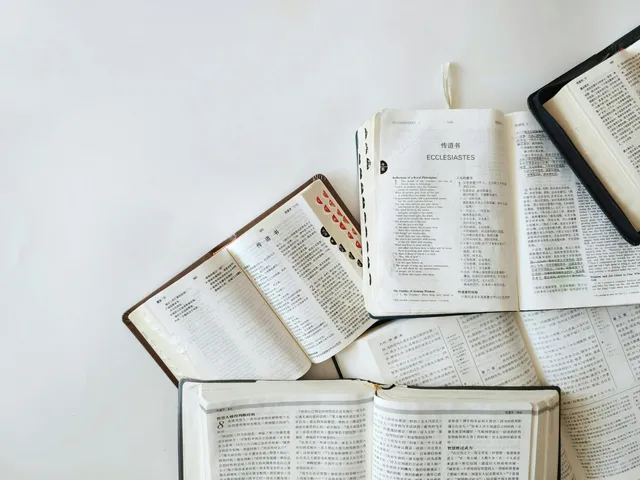
When we walk into a Christian bookstore-or open a Bible app-we're often greeted not by one Bible, but by dozens: NIV, ESV, KJV, NKJV, NLT, CSB, NASB, The Message, and more. It can feel overwhelming. Why so many? Did God's Word change? Is one version more "holy" than the others? Or does this diversity say something beautiful about the living nature of Scripture and the way God keeps meeting His people across time and culture?
The Heart Behind the Question
At the core of the question "Why are there so many versions?" lies a deeper longing-to hear God clearly. Every sincere believer who opens the Bible desires not just accuracy but connection. We want to grasp what God said and what He is still saying. And throughout history, God's people have wrestled with how to best preserve, translate, and share that Word.
From One Tongue to Many: The Early Story
The Bible began in three languages-Hebrew, Aramaic, and Greek-encompassing more than a thousand years of human history and divine Revelation. When Jesus quoted Scripture, He most often used the Greek translation of the Old Testament called the Septuagint. Already, in His day, there were "versions." And the Lord didn't seem bothered by that. He spoke the truth, regardless of translation. That tells us something profound: the Spirit transcends language.
As Christianity spread from Jerusalem to Rome to Alexandria and beyond, translations multiplied. Believers in Egypt needed Scripture in Coptic; in Syria, in Syriac; and in North Africa, in Latin. The Word was on the move, crossing boundaries as Christ Himself commanded: "Go and make disciples of all nations." (Matthew 28:19)
How History Shaped the Versions
Of course, the journey from parchment to printed page wasn't smooth. Before the printing press, copies were made by hand-carefully, reverently, sometimes imperfectly. Scribes made small corrections or clarifications, which grew into a handful of variations over centuries. Yet, remarkably, modern scholarship has found that those small differences never changed the essential message of the Gospel. God's Word, preserved through human hands, remained intact in its core truth.
The Age of the Printing Press and the King James Legacy
When Gutenberg's press emerged in the 15th century, the dream of a Bible for every believer became real. Less than a century later, the King James Version was commissioned in 1604. For many English-speaking Christians, the KJV became synonymous with the Bible itself-majestic, eloquent, and enduring. But even in its day, it was one of several translations. What set it apart was its artistry and authority, capturing both reverence and rhythm in language that stirred the soul.
Centuries passed. Languages evolved. Words changed meaning. What once sounded familiar now felt archaic. Human understanding of ancient manuscripts also deepened, as scholars discovered earlier copies of biblical texts closer to the originals. This gave birth to a new wave of translations, seeking to refresh clarity without losing reverence.
Different Approaches, Same Mission
All Bible versions share a common goal: to make the Word of God clear and faithful to its intended meaning. Yet translators often take different paths to achieve that balance. The two main approaches are known as formal equivalence and dynamic equivalence.
Formal Equivalence - Word for Word
Translations like the ESV, NASB, or KJV aim for a word-for-word approach, staying as close as possible to the original structure. Readers get a sense of how Scripture was phrased thousands of years ago, but sometimes at the expense of modern readability. For serious study or liturgical use, these versions shine. They invite us into the ancient cadence of God's speech.
Dynamic Equivalence - Thought for Thought
Other translations, like the NIV or NLT, prioritize meaning over form. The translators ask, "How would the original writers say this if they spoke today?" The result is often smoother, vivid, and more accessible for new believers or daily reading. It's less like gazing at a museum artifact and more like walking beside Jesus on a dusty road, hearing His heart in familiar language.
Neither method is more "spiritual." Both honor the sacred text; they simply serve different purposes. Think of it as two lenses focusing on the same truth-one detailed, one panoramic-but both revealing Christ.
Language, Culture, and God's Ongoing Voice
Every translation is also a cultural moment. When translators sit with ancient Greek verbs or Hebrew poetry, they're not just turning words into modern equivalents-they're bridging entire worlds. And that's the miracle: that God's Word keeps walking across those bridges without losing its life.
Consider John 1:14-"The Word became flesh and dwelt among us." God's message didn't remain abstract or locked in divine speech. It took on flesh, walked, spoke, and wept among people. Likewise, when Scripture takes on a new language, it takes on a new "flesh." A Bible in Swahili, Spanish, Mandarin, or modern English is not a dilution of the Word but a continuation of the Incarnation-God becoming understandable to people where they are.
When Different Versions Help Us Hear More
Sometimes, reading different translations can illuminate truth in ways a single one cannot. For example, Psalms 23:1 in one version reads, "The Lord is my shepherd; I lack nothing." Another says, "I shall not want." The first feels modern and declarative; the second poetic and yearning. Both convey the same trust. Reading both gives us a fuller picture of the Shepherd's care.
Like facets on a diamond, these translations reflect the same light from different angles. God's truth hasn't changed-the prism through which we see it simply shifts, enriching our worship and understanding.
Unity in the Midst of Variety
In some Christian circles, debates about which version is "best" can grow heated. But Paul reminds us that Christ is not divided (1 Corinthians 1:13). The beauty of multiple translations is not confusion but abundance. The diversity of Bibles mirrors the diversity of the Church itself-many voices, one Spirit. The same God speaks through each version to hearts longing to hear Him.
The Work of Translators-and the Whisper of the Spirit
Behind every Bible you open stands not only scholars and linguists, but prayerful men and women who believe they are handling holy ground. They spend years weighing the meanings of words, studying ancient contexts, and praying through their decisions. Yet even their careful craft depends on something beyond scholarship: the Spirit who breathes life into every page.
Jesus promised that the Holy Spirit would guide His followers into all truth (John 16:13). That promise is still being fulfilled in every generation's translation efforts. The Spirit ensures that while language changes, the heartbeat of Scripture stays alive and faithful. The living Word can never be trapped by one grammar or one era-it's always breaking out into the world anew.
How to Choose-and How to Listen
So how should a believer choose among the many versions? The answer might be simpler than it seems. Pick one that you can understand deeply and read consistently. If a translation brings life to your soul, draws you closer to Christ, and helps you live His Word-then it's serving its purpose. Many Christians keep several versions for different uses: one for devotional reading, one for study, one for public worship. It's not about picking the "best," but finding what helps you walk with God faithfully.
As you read, let the Holy Spirit be your interpreter. Versions can inform you, but only the Spirit can transform you. A printed page becomes a personal word when His voice speaks through it. Whether you read the Psalms in the lyrical cadence of the King James or the plainspoken clarity of the NLT, it is still the same Shepherd calling your name.
When God Speaks in Our Own Language
Missionaries often tell of villages hearing the Bible read in their heart language for the first time. People weep openly. One pastor in Papua New Guinea said, "It's like God moved into our neighborhood." That's the heart of every translation-that every person, from every tribe and tongue, might know the God who has already come near.
Revelation 7:9 paints the vision of heaven: a multitude from every nation, worshiping before the Lamb. How fitting that on earth, too, His Word is voiced in every language. The many versions of the Bible are not a sign of division, but a preview of that day when every voice will join together in one Song of Songs of praise.
A Living Word for a Living People
The Bible has so many versions because God's Word is alive-and living things grow, adapt, and move. The message is eternal, but the expressions are many, tailor-made for hearts across ages and cultures. God is still speaking, not by creating new Scripture, but by continually breathing life into the Scripture we already have so that it might keep speaking fresh hope to every generation.
At the end of the day, the question isn't "Which version should I read?" but "Will I listen when God speaks?" When we open the Bible in faith, whatever translation lies in our hands, heaven still breaks through the page. And in that holy moment, the many versions become one voice-the voice of the Lord who says, "Be still, and know that I am God."
The Bible's many versions are proof not of God's silence, but of His endless desire to be heard.