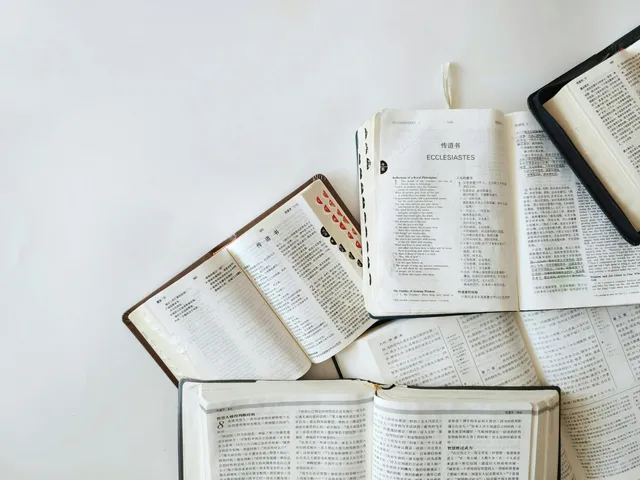
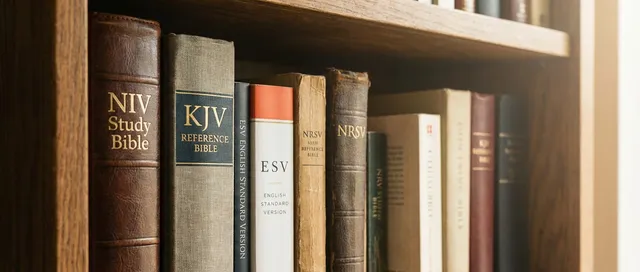
Walk into any Christian bookstore-or open an app-and you'll find shelves and screens filled with dozens of Bible translations. The New International Version. The English Standard Version. The New Living Translation. The King James Version, the Message, the Christian Standard Bible-the list goes on. For some believers, this abundance is a blessing: there's a translation for every style, age, and reading level. But for others, it can be bewildering. Why are there so many versions of one holy book? Shouldn't God's Word be the same everywhere?
The Living Word in Human Words
The heart of the answer begins with this truth: the Bible is both divine and human. God breathed His Word (2 Timothy 3:16), yet He inspired it through human authors-men and women who lived in specific times, spoke particular languages, and were shaped by distinct cultures. The Hebrew of the Old Testament, the Aramaic passages in Daniel, the Greek of the New Testament-each carries nuance, rhythm, and meaning that don't always have a direct equivalent in another tongue.
When translators sit down to render Scripture into modern languages, they step into that holy tension: how to communicate eternal truth through the temporary medium of human speech. It's not unlike what happened at Pentecost, when the Holy Spirit allowed the apostles to speak the same Gospel in many languages at once (Acts 2:6). The message was unchanging; the expression was varied.
Words Change. God's Truth Does Not.
Language is alive. It evolves with every generation. The English you're reading now is not the English of the sixteenth century-nor even of your grandparents' time. Words shift in meaning, tone, and clarity. The King James Version, completed in 1611, remains a monumental translation and a work of literary brilliance. But many of its words have drifted in meaning. Where it reads "suffer the little children," modern readers might misunderstand "suffer" as pain rather than "allow."
That's why new translations appear: not because God's Word is changing, but because people are. Translators labor to keep Scripture understandable and faithful for each new era and community. It's an act of stewardship, not revision.
Literal, Dynamic, and Everything Between
Different translations reflect different philosophies of how best to bridge the gap between ancient text and modern reader. Formal equivalence (sometimes called "word-for-word") attempts to stay as close as possible to the grammatical structure of the original languages. The English Standard Version (ESV) or New American Standard Bible (NASB) fall near this approach. They're treasured by those who want to see the exact phrasing of Scripture, even if it sometimes reads a bit stiffly.
Then there's dynamic equivalence ("thought-for-thought"), which prioritizes clarity and natural expression. The New International Version (NIV) and New Living Translation (NLT) aim to communicate the intent of the text rather than its literal syntax, helping modern readers absorb the meaning as ancient readers once did.
And finally, there are paraphrases like The Message or The Living Bible-free renderings meant to ignite understanding and devotion. These aren't replacements for study, but they can open hearts by expressing familiar truths in fresh language.
Carrying the Light Across Cultures
Another reason there are so many translations is that the Bible has gone global. When the Gospel began spreading beyond Jerusalem in the book of Acts, it crossed languages, customs, and worldviews. The early church quickly realized what missionaries through history have discovered again and again: every culture hears God's Word best in its own tongue.
Today, translations continue in thousands of languages worldwide-not only because of diversity, but because within a single language, like English or Spanish, new contexts keep emerging. There are versions written in simplified English for new readers, versions designed for children, translations for academic study, and those crafted for public reading in worship. The message doesn't change; the vessel adapts.
Scripture in the Heart Language
Wycliffe Bible Translators tell endless stories of how lives are changed once a community reads Scripture in its heart language. One translator recounted a man saying, "Now we know that God speaks our language too." That is what every translation proclaims: the God who stooped to take on flesh also stoops to speak our words.
A Mirror of the Church's Longing to Understand
Having so many translations is also a reflection of the Church's diversity and devotion. Across centuries, Christians have wrestled with how best to understand the mysteries of God's Word. Each translation is, in a sense, the Church saying, "We want to know Him more clearly." Whether the translator is a scholar poring over Greek verbs or a pastor working to help his congregation grasp a Psalms, the motivation is often the same: a deep love for Scripture and its Author.
Sometimes, of course, debates arise. Which version is "best"? Which is "truest"? But rather than dividing us, these questions can invite us deeper-reminding us that no single translation can monopolize God's voice. The prophet Isaiah wrote, "The grass withers, the flower fades, but the word of our God will stand forever" (Isaiah 40:8). The Word stands eternal, even as our renderings shift with the ages.
The Challenge and Beauty of Translation
Translation always involves trade-offs. There are Hebrew words so rich they carry multiple shades of meaning-like hesed, often rendered as "lovingkindness," "steadfast love," or "mercy." None of those fully capture it, and yet all try. Translators pray, research, and labor with reverence, aware that they are handling sacred fire.
One might say translation mirrors incarnation: divine truth taking on the form of human language so that God's people can draw near. Jesus, the living Word, dwelt among us in flesh (John 1:14). In a much smaller way, every translation embodies that same grace-the eternal meeting the everyday.
Unity Amid Variety
It's easy to see the multiplicity of translations and worry it signals confusion or division. But perhaps it's evidence of the opposite: that God's Word is vast enough to meet people of all nations, ages, and intellects right where they are. Different translations do not fracture the truth; they refract it-like facets of a diamond, each catching a different glimmer of eternal light.
Reading With Fresh Eyes
Many believers find deep enrichment in reading multiple translations. A verse that once felt familiar can strike the heart in new ways when phrased differently. The poetic language of the King James might stir reverence; the clarity of the NLT might invite intimacy; the precision of the ESV might sharpen understanding. Seeing the same truth expressed from different angles draws us deeper into Scripture's living voice.
When we open various translations side by side, we are entering a centuries-long conversation with believers across time and culture. We're reminded that the Spirit who inspired Scripture is still active, still speaking, still opening minds and hearts.
God's Word: Anchored and Alive
Some fear that multiple translations threaten the unity or trustworthiness of Scripture. But Jesus' promise still stands: "Heaven and earth will pass away, but My words will never pass away" (Matthew 24:35). Translations may differ, but they all trace back to manuscripts lovingly preserved through generations and to the same unchanging Savior they proclaim. The Bible's message has never shifted-it has only found new ways to be heard.
In a world where voices compete for attention and truth feels fragile, the many translations of the Bible testify to God's determination to be understood. No barrier of time, tongue, or tradition can silence Him. He keeps speaking, generation after generation, through every faithful rendering of His Word.
A Devotional Reflection for the Reader
Maybe you have your favorite translation-the one where the familiar words feel like home. That's beautiful. But perhaps there's also value in occasionally stepping beyond it. Try reading the same Psalms in three different versions. Notice what God emphasizes anew. Ask the Spirit to show you His heart through the diversity of language.
Every translation is, at its best, a reminder that God is not distant or abstract; He is close enough to speak in your own language-whatever that may be. He is the Word made flesh who meets us, not only on ancient scrolls, but in the pages of our daily reading and the rhythm of our everyday lives.
In the End, One Word
So why are there so many Bible translations? Because the God who authored Scripture is infinitely loving and endlessly communicative. Because He cares enough to meet His children in every culture, every generation, every dialect and accent and heart-language. Because He wants to be known.
When you pick up your Bible-whether it says NIV or NRSV, KJV or CSB-remember that behind all the linguistic labor and historical nuance stands a God who delights in conversation. The abundance of translations is not a sign of confusion but of grace. It is evidence that the living Word still speaks.
And as you listen, may the pages draw you past the letters and into His presence-the One who remains the same yesterday, today, and forever.