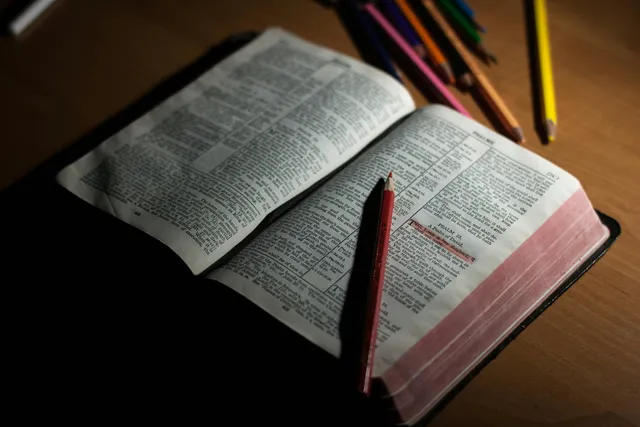
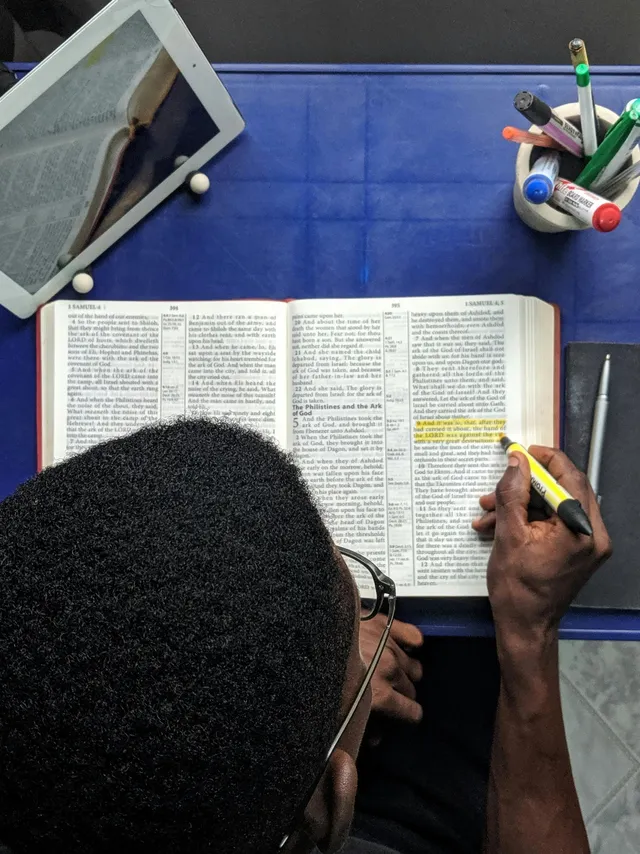
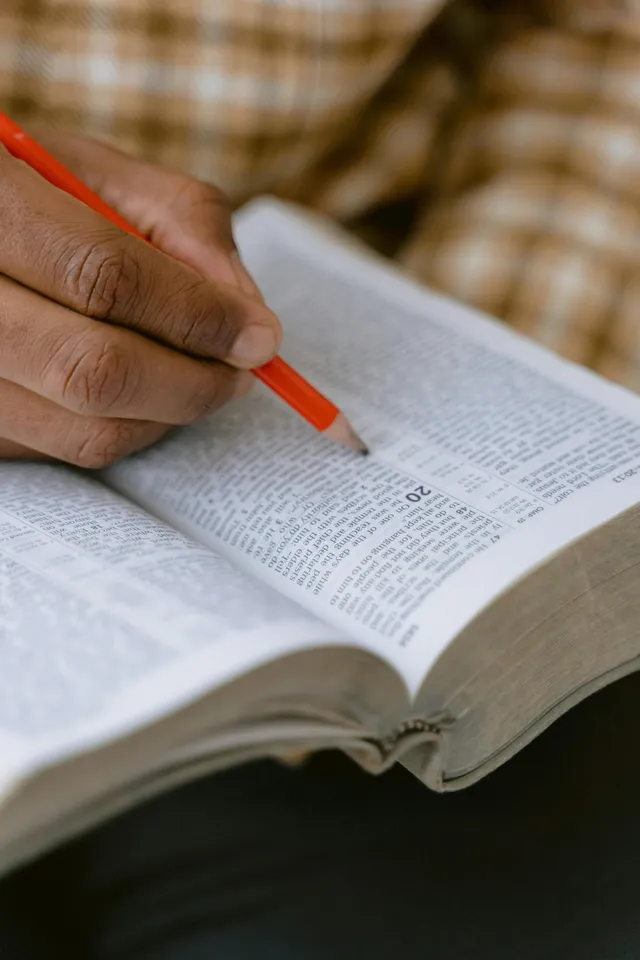
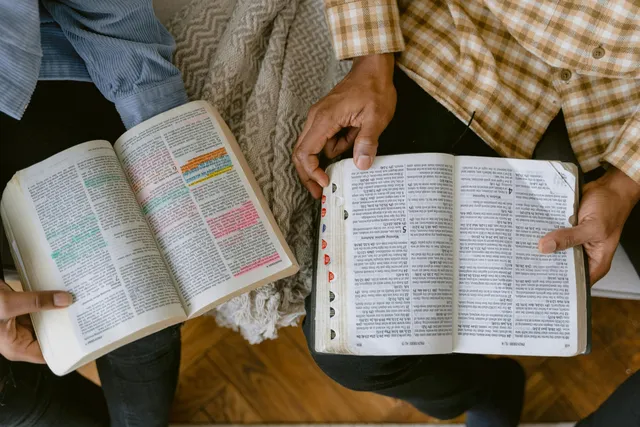
You finished three chapters before work. You are reasonably sure one of them was in Kings. By lunch, nothing remains except a vague sense of having done the right thing, the way you feel after flossing. This is not a crisis of faith. It is a crisis of attention, and almost every serious Christian reader I know has felt it: we are covering more ground than we can absorb, and the words are running off us like rain off a roof.
The Bible has an old answer to this, and it is not "try harder." It is slower. Scripture assumes a kind of reading that most of us have never been taught, one that treats a single sentence the way you might treat a stubborn knot: turning it, working it, staying with it long past the point where you would normally move on. The Hebrew Bible calls it meditation. It was never meant to be an advanced practice for spiritual athletes. It was meant to be ordinary.
What we lost when we learned to read fast
Silent, rapid reading is a fairly recent human skill. For most of history, reading was something you did with your mouth. Ancient readers murmured the text, and the sound of a library was a low hum of voices. When Philip encountered the Ethiopian official in Acts 8, he "heard him reading Isaiah the prophet" (Acts 8:30). He heard him, from the road, because that is what reading sounded like.
That physical detail matters more than it seems. When you read aloud, you cannot skim. Your eyes cannot leap ahead of your tongue. You are held to the pace of speech, roughly a hundred and fifty words a minute, which is glacial compared to how quickly a trained modern reader can scan a page. Everything in our formation has pushed us toward speed: standardized tests, email, the endless scroll that rewards gist over substance. We have become excellent at extracting the point and terrible at dwelling on it.
The result is a strange kind of poverty. Many Christians have read the whole Bible and can quote almost none of it. We know the general shape of Romans 8 but could not tell you what verse 26 says. We have consumed the text without ever chewing it. And the Bible, as it happens, is very interested in chewing.
Meditation that fills rather than empties
The word in Psalms 1 is hagah, and its other uses in the Old Testament are wonderfully unspiritual. In Isaiah 31:4 it describes a lion growling over its prey, refusing to be driven off by a crowd of shepherds. In Isaiah 38 it describes a sick man moaning. It is a throat word, a low and involuntary sound. To meditate on God's law in the biblical sense is to mutter it, to growl over it, to keep making noise about it because you will not let it go.
This is worth saying plainly, because the word "meditation" has drifted. In much popular usage it means detaching from thought, observing the breath, clearing the mind of content. There is nothing sinister about relaxation, and Christians can certainly benefit from stillness. But biblical meditation moves in the opposite direction: it is not the emptying of the mind but the filling of it. You are not trying to get to a place with no words. You are trying to get one particular set of words so deep into you that they surface uninvited.
Psalms 119, that enormous love Song of Songs to the Scriptures, keeps using a second word, siach, which means something like musing or rehearsing. "I will meditate on your precepts and fix my eyes on your ways" (Psalms 119:15). The image is of a person talking something over, possibly with themselves, going back through it the way you go back through a conversation that mattered. Mary does this after the shepherds arrive at the manger: she "treasured up all these things, pondering them in her heart" (Luke 2:19). She does not analyze. She holds.
The tree that does not notice the drought
Psalms 1 sets the whole practice in a single picture, and it repays a slow look. The blessed man's "delight is in the law of the LORD, and on his law he meditates day and night" (Psalms 1:2). Then the payoff: "He is like a tree planted by streams of water that yields its fruit in its season, and its leaf does not wither."
Notice what the tree is not doing. It is not straining. It is not producing fruit by an act of will. It is simply located somewhere, near water, with roots that have quietly found their way to the source. The fruit comes "in its season," which implies waiting, and dormancy, and a good deal of time when nothing visible is happening. The Psalms is not promising that meditation makes you productive. It is promising that meditation makes you rooted, and that rootedness eventually shows.
The contrast in verse 4 is brutal in its simplicity: the wicked "are like chaff that the wind drives away." Chaff is the light, dry husk that separates from the grain at harvest. It has no roots at all. It goes wherever the air is moving. If you have ever felt like your convictions shift with whatever you last read or whoever you last talked to, the Psalms has named your condition, and it has also named the remedy. Depth is not a personality trait. It is what happens to people who stay in one place long enough to grow roots.
Joshua's strange preparation for war
Then there is Joshua 1:8, which is arguably the odder text of the two. Moses has died. Joshua is about to lead a nation of former slaves across a flooded river into fortified territory. God's instruction for this moment is not a military briefing. It is this: "This Book of the Law shall not depart from your mouth, but you shall meditate on it day and night, so that you may be careful to do according to all that is written in it."
Two things stand out. First, the location: "shall not depart from your mouth." Again the muttering, the audible rehearsal. Joshua is to have the words moving through him constantly, the way a soldier keeps a weapon within reach. Second, the purpose: "so that you may be careful to do." Meditation here is not contemplative in the sense of being detached from action. It is the mechanism by which the words become behavior. You cannot obey a text you cannot remember at the moment it applies.
This is the practical logic of the whole discipline. Nobody looks up a verse in the two seconds before they say something cruel. Nobody opens a concordance in the middle of a panic attack. What we have available in those moments is only what has already sunk in. Deuteronomy 6 says the words are to be on your heart, and then talked about at home, on the road, lying down, getting up (Deuteronomy 6:6-7), which is not a curriculum so much as a description of saturation.
How to actually slow down
The good news is that the practice is not complicated. The difficulty is entirely in the doing, and mostly in the first ten minutes, when your mind will object loudly to the pace.
Shrink the portion
Take one paragraph. Not one chapter, one paragraph, or even one verse. If you are used to reading three chapters a day, this will feel like cheating, and that feeling is the exact thing you are trying to unlearn. Read it, then read it again, then read it a third time. Somewhere in the second or third pass, your eyes will stop sliding and you will notice something: an odd word, a connection to what came before, a claim you had never quite registered. That noticing is the whole point.
You can keep a broader reading plan alongside this if you like. Many people read widely on one track and slowly on another. But do not let coverage crowd out depth. Reading the Bible through in a year is a fine goal; being changed by it is a better one.
Read it out loud
Even in a whisper, even feeling foolish. Your comprehension changes when your throat is involved. Sentences you have heard a hundred times will suddenly have a shape and a stress you had never heard. Try reading a Psalms aloud slowly enough that you can hear the parallel lines answer each other, and you will understand why Hebrew poetry works.
Ask the text questions and let it answer
Why this word and not another? What is this verse assuming that I do not assume? Who is being addressed, and what would they have heard? If the passage makes a promise, what exactly is promised, and what is not? If it gives a command, what would obeying it cost me this week? Write the questions down if it helps. You are not performing exegesis for a grade. You are having a conversation with someone who has more to say than you expected.
Carry one line into the day
Pick a phrase short enough to memorize before you close the book. "The LORD is my shepherd." "Be still, and know that I am God." "Let the word of Christ dwell in you richly" (Colossians 3:16). Then return to it: in line at the pharmacy, in the ten seconds before a hard conversation, at the red light. This is not magic and it is not a mantra. It is rehearsal, the way you rehearse a phone number you cannot afford to lose.
Pray the passage back
Turn what you have read into address. If the text says God is a refuge, tell him you need one and name what you are hiding from. If it convicts you, confess. If it makes a promise you do not feel, say so honestly; the Psalms are full of people doing exactly that. Meditation without prayer becomes analysis, and prayer without Scripture tends to shrink down to the size of our own worries. Together they make a conversation.
The part nobody warns you about
Slow reading is often boring at first. You will sit with a verse for four minutes and produce nothing but a grocery list and a memory of something embarrassing you said in 2014. This is normal, and it is not a sign that you lack the temperament for it. It is a sign that your attention has been trained by other things and is now being retrained, which is uncomfortable in the same way that a first week of running is uncomfortable.
The other temptation is to measure. You will want the sessions to produce insight, preferably insight worth sharing. But a tree by the stream is not evaluating its own root growth. Some mornings you will see something that reorders your week. Most mornings you will simply have been there, attentive, with the words. Jeremiah described finding God's words and eating them, and said "they became to me a joy and the delight of my heart" (Jeremiah 15:16). He does not say every meal was memorable. He says he was fed.
After a month
Here is what people typically report, and it is less dramatic and more useful than they expected.
The first change is that verses start showing up on their own. You will be driving, or refereeing an argument between your children, or lying awake at two in the morning, and a line you sat with two weeks ago will arrive unbidden. This is what Psalms 1 means by meditating "day and night." It does not describe a schedule of ten-hour devotions. It describes a mind that has been given something to hum.
The second change is that the Bible starts to feel less flat. Passages you had filed as familiar develop texture. You begin to notice the connective tissue, the way a phrase in Isaiah turns up in Matthew, the way the Gospels quietly assume you know the Psalms. Jesus in the wilderness answers every temptation with Deuteronomy, not because he was consulting a scroll but because the words were in him. The more you slow down, the more you see that the whole book is written for people who read it that way.
The third change is the hardest to describe and the most important. Your reactions begin to shift slightly before your convictions do. You catch yourself being patient in a situation that would ordinarily have gotten the sharp version of you. You find that a fear that had been running the show has lost a little of its grip, not because you argued yourself out of it but because something truer has been taking up room. Scripture does its deepest work below the level of decision, in the layer where our instincts are formed. That layer changes slowly, by repetition, which is precisely why speed does not help.
So take a paragraph tomorrow. Read it three times, out loud, before anyone else in the house is up. Pick one line and carry it around all day like a stone in your pocket, taking it out when you have a moment to spare. Do that for a month, and you will not have covered much ground. You will have gone down instead, toward the water, where the roots go.