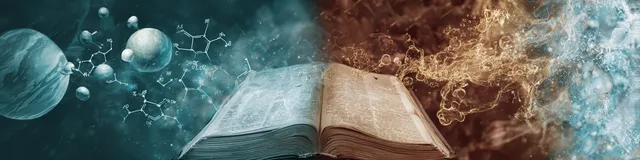
There's a moment in every believer's journey when faith and reason seem to stand on opposite shores, calling across a foggy sea. The scientist within us asks questions, seeks evidence, demands reproducibility. The believer within us looks up to the heavens, kneels in prayer, and confesses that life itself is a miracle. Must these two voices-faith and reason-be in conflict? Or could it be that, when truly understood, miracles and science are not adversaries but companions in the search for truth?
When the Impossible Meets the Observable
A miracle, by definition, defies explanation-or so it seems. It is the suspension of natural law, the divine fingerprint left on human history. Jesus turning water into wine (John 2:1-11), the blind gaining sight, the dead rising to life-each of these stories invites us to see beyond the visible and into the heart of the God who spoke everything into existence.
Science, on the other hand, seeks understanding through observation and pattern. It maps the veins of the universe, studies the tiniest cells, and peers into atoms and galaxies alike. It does not deny wonder-it measures it.
But here's the profound truth: Both miracle and science begin with awe. One gazes through the telescope and sees the glory of God in the nebula; the other gazes through faith and sees His glory in the new life of the redeemed.
The Same Author of Both Books
Theologians have long spoken of creation as the "Book of Nature," complementing the "Book of Revelation"-Scripture itself. If God authored both, then truth cannot contradict truth. What science uncovers and what faith declares are parts of a unified symphony.
All truth is God's truth. The law of gravity, the DNA code, the constants that hold the universe together-these are not independent of God but expressions of His order. The same Creator who crafted the laws of physics also chooses, at times, to write a new sentence in the story by means of a miracle. This is not conflict; this is creativity.
Miracles as Signposts, Not Violations
We often think of miracles as intrusions into the natural order, but the Bible portrays them as deeper revelations of reality itself. When Jesus calmed the storm, He wasn't undoing physics; He was showing that all creation ultimately answers to its Creator. When He walked on water, He was not mocking science-He was manifesting sovereignty over the elements.
A miracle doesn't negate natural law; it reveals a higher law that governs both the seen and unseen realms.
The Scientist and the Psalmist
Perhaps one of the most beautiful harmonies between science and faith is found in the shared language of awe. The Psalmist declared, "The heavens declare the glory of God; the skies proclaim the work of His hands" (Psalms 19:1). Modern astronomers would agree that the heavens indeed declare something magnificent-galaxies beyond number, stars being born, light traveling millions of years to reach our eyes.
The difference is not in the observation, but in the explanation. Science describes, faith interprets. Science can measure the brightness of a star; faith marvels at the One who lit it.
The Wonder of Discovery
Every major scientific discovery carries within it a spark of worship-even if the scientist doesn't name it as such. When Einstein described the universe as "comprehensible," he was, in essence, marveling at divine reason. When a biologist discovers the delicate balance within a living organism, the response, whether conscious or not, is one of awe before the intricacy of divine order.
Thus, science at its best is not opposed to faith-it is an expression of it. To study creation is to study the handwriting of God. To explore the mechanics of life is to peer into the workshop of the Divine.
Faith Beyond the Microscope
We do run into tension when we ask: What about things science cannot explain? Does mystery automatically equal miracle? Not always-and yet, the presence of mystery reminds us of our limits. Each new horizon in human discovery reveals deeper questions beneath.
Faith doesn't demand we abandon science. It asks us to hold humility alongside curiosity. The believer says: I look at all that is known and still trust the One who knows beyond it.
In that sense, miracles don't compete with knowledge; they complete understanding. They point to the reality that there is more in heaven and earth than any microscope or telescope could reveal.
Jesus and the Scientist in You
Remember when Thomas needed to touch the risen Christ's wounds to believe? Jesus didn't scold him; He met him there. God isn't threatened by investigation. He welcomes sincere seekers, whether they come with microscopes or mustard seeds.
Something beautiful happens when a believer dares to pursue both scientific truth and spiritual truth: they begin to see that the laws of nature are the rhythms of grace. Every heartbeat and every breath, measured or unmeasured, become acts of divine mercy.
The Everyday Miracles
Maybe the question is not just whether miracles and science can coexist, but whether we can recognize the miraculous within what science describes. The sunrise is predictable, the seed germinates according to biological principles-but isn't it still miraculous that light returns after darkness and life springs from death?
Sometimes we miss the wonder because we've explained it too well. But faith reminds us that behind every equation is an Artist whose elegance cannot be reduced to numbers.
History's Harmonies
Not all who pursue science have doubted God. Many of the pioneers of modern science-Kepler, Newton, Faraday, Pasteur-saw their work as worship. They believed that by uncovering the order of creation, they were uncovering the thoughts of the Creator.
Kepler once wrote that in studying astronomy, he was "thinking God's thoughts after Him." Newton spent as much time writing about Scripture as he did about gravity. For these great minds, there was no divide between the laboratory and the chapel; both were sacred spaces.
Science without wonder becomes sterile; faith without curiosity becomes shallow. God invites us to both-reverent awe that asks questions and humble faith that finds meaning in the answers.
When Faith Walks Through the Data
Our modern world often forces a false choice between believing in miracles or believing in science. But this choice dissolves when we see that both belong to the same Creator's tapestry. When a doctor witnesses a recovery beyond explanation, or a physicist encounters constants fine-tuned for life, they touch the edges of miracle, even if they call it by another name.
Faith doesn't fear scientific progress; it rejoices in truth. For every time we map a new gene or photograph a distant planet, the boundary of our awe expands. God doesn't shrink when we learn more-He grows larger in our understanding.
Doubt, Discovery, and Devotion
It's normal, even holy, to have questions. Doubt is not the enemy of faith-it is often its doorway. When we wrestle with how the Red Sea parted or how light itself behaves like both wave and particle, we are, in a sense, standing on holy ground. We are acknowledging that our intellect is finite, and yet, in that finiteness, God meets us with infinite patience.
The mature believer doesn't seek to explain away the miraculous or reject the observable-they stand in awe of both. For in both, we hear the same divine whisper: "Be still, and know that I am God" (Psalms 46:10).
The Living Miracle Within You
Look no further than your own heartbeat. Every electrical signal firing through your body, every cell working in harmony, is a marvel of biological precision-and also of divine care. The God who numbers the hairs on your head also programmed the pattern of your DNA. The Architect of creation is as intimately involved in your being as He is in the galaxies.
That is perhaps the greatest miracle science can illuminate: that you and I exist at all. Out of cosmic dust and divine breath, life emerged-not as a random accident, but as an intentional act of love.
Living in the Harmony
So can miracles and science coexist? Not only can they-they must. For both arise from the same source: a God who delights in both order and surprise. Science maps the pathways of His design; miracles remind us that He still walks among them.
To live in this harmony is to see every sunrise as both a physical event and a spiritual promise. It is to study the world deeply, humbly, and joyfully, trusting that the more we learn, the more we'll see His fingerprints. The believer doesn't fear discovery; the believer expects it, because truth always leads home.
An Invitation to Wonder
Today, as you notice the details of creation-the structure of a leaf, the orbit of the moon, the quiet rhythm of your own breathing-pause to thank the God of both miracles and molecules. Let curiosity become worship. Let learning become praise. And when mystery remains, let it deepen your trust, not your doubt.
For the Author of science is also the Worker of wonders, and in Him, the miraculous and the measurable are not at war, but in perfect harmony.