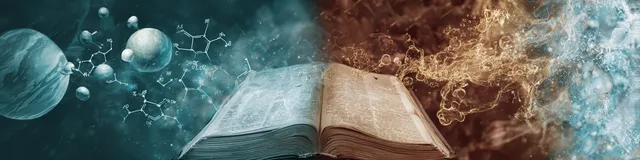
How can a faithful Christian speak about evolution without losing faith-or hope? It's a question that has stirred hearts for generations, and for good reason. Yet, at its core, the conversation is not just about science and Scripture-it's about trust, humility, and wonder before a Creator who continues to reveal Himself through His world.
When Faith Meets Curiosity
Many believers remember that uneasy moment in high school biology when the word "evolution" first made its way onto the whiteboard. It can feel like an intrusion-one story of origins brushing up against another. Yet what if that tension could be a place of growth rather than fear? Faith is not a fragile candle that scientific discovery can blow out. It is a steady flame bright enough to illuminate even the corners of our questions.
Genesis begins not with a lab report but with poetry-rhythm, beauty, and purpose. "In the beginning, God created the heavens and the earth." (Genesis 1:1) This declaration is not primarily about how God made the world, but that He made it, and that it was good. The opening chapters of Scripture do not aim to rival a textbook; they reveal a relationship between Creator and creation.
Learning to Listen Without Fear
Sometimes Christians approach scientific ideas defensively, as if every fossil unearthed threatens our faith. But Scripture calls us to something gentler, wiser, and more patient. "Be quick to listen, slow to speak, and slow to become angry" (James 1:19). The same applies here: listen first. Listen to scientists who are honestly exploring God's world. Listen to theologians who wrestle with what Genesis means in light of modern knowledge. Most importantly, listen for the still, small voice of God within your own questions.
Before we speak about evolution, we need to cultivate the kind of spiritual posture that allows us to hear. It's not about having perfect answers-it's about bearing the fruit of humility and peace while we seek understanding. Faith grows not when we control all mysteries, but when we surrender them into God's wisdom.
Between Bible and Biology
One of the most painful misunderstandings comes from assuming we must choose between the Bible and science. But the same God who speaks through Scripture also crafted the processes of nature. Revelation is not divided; it is diverse.
Psalms 19 declares, "The heavens declare the glory of God; the skies proclaim the work of His hands." If the heavens can declare God's glory through beauty and motion, why couldn't the deep history of life on Earth also tell part of that story? Evolution, viewed through the eyes of faith, may reveal not random chaos but the unfolding creativity of a generous God.
The Bible's Deeper Aim
The first chapters of Genesis offer truth beyond chronology. They reveal intent: God's authority, humanity's purpose, and creation's goodness. That truth stands, whether the earth is young or ancient, whether species appeared suddenly or gradually. The heart of Scripture's message is not a timeline-it's relationship.
Respecting the Landscape of Science
It helps to remember what science is-and what it is not. Science studies processes, mechanisms, and patterns within creation. It asks, "How did this happen?" Faith asks, "Why does this matter?" These are complementary questions. When biologists study evolution, they're tracing patterns of change in species over time. That study doesn't automatically disprove divine agency-it merely describes the tools of creation that might be used by the Creator Himself.
God's Continuous Creativity
Christians throughout history have envisioned creation as a living, ongoing act. The theologian Augustine wrote more than 1,500 years ago that God could have created potentialities in nature that unfold over time. That ancient insight resonates deeply with modern discoveries. To believe that God creates through process is not to diminish His power-it is to marvel at His patience and artistry.
Holding Tender Conversations
When we talk with others-especially within the church-about evolution, tone matters as much as content. Pride often divides, but listening unites. Remember that for some, this topic touches on childhood memories of Sunday School or fears that accepting evolution means rejecting Scripture. We must handle those feelings not with ridicule, but with compassion.
When someone asks, "Do you believe in evolution?" it can help to reframe the question: "I believe in a Creator who is actively involved in His world. What scientists describe as evolution, I see as one way His creativity unfolds." Suddenly, the discussion moves from competing claims to shared awe. Faith becomes a lens, not a barrier.
When Doubt Comes Calling
Even the most devoted believer may feel moments of uncertainty. Perhaps you've gazed at the complexity of DNA or watched a documentary that stirred more questions than answers. Know this: doubt is not the enemy of faith; silence is. What weakens faith is not curiosity, but isolation in confusion. Scripture gives us space to wrestle. Think of Jacob clinging to the angel through the night (Genesis 32:26). Faith clings even when it doesn't fully comprehend.
Doubt can be a holy teacher. It pushes us to seek, to pray, to learn. If every question unsettles us, then perhaps we have anchored our faith in explanations rather than in God Himself. True faith finds peace not in having every answer, but in trusting the One who holds every mystery.
The Witness of Wonder
Perhaps one of the most powerful ways Christians can engage the topic of evolution is through wonder. When we step outside beneath a starry sky, we do not first analyze distances or timelines-we worship. When we look at the intricate beauty of a flower, we don't need to choose between the poetry of Genesis and the chemistry of photosynthesis. Both sing the same hymn of glory in two different languages.
Wonder bridges what arguments divide. It transforms scientific observation into doxology, turning knowledge into worship. A Christian who learns about DNA or the age of galaxies isn't betraying the Bible-they're entering more deeply into the mystery of God's creativity. Every discovery can become an altar of praise.
The Example of Jesus
Jesus often used the natural world to teach spiritual truth-sparrows, seeds, vines, and lilies. He never feared creation's complexity; He illuminated it. In Him, science and Spirit converge: "Through Him all things were made" (John 1:3). Christ holds both Scripture and nature together in perfect unity, reminding us that truth, wherever found, ultimately belongs to God.
Living the Conversation Out
So how do we live this conversation practically? It begins with humility-in classrooms, pulpits, and family tables. We can speak about evolution without surrendering our reverence for God's Word, and we can revere Scripture without dismissing honest science. We can model curiosity anchored in faith, showing the next generation that asking questions is itself an act of trust in the God who made minds capable of inquiry.
Surround these discussions with prayer. When you encounter a scientific claim that challenges your understanding, pause and offer it back to God: "Show me how to see You here." Such a simple prayer transforms confusion into communion.
Faith for a Larger World
In the end, to talk about evolution as a Christian is to speak about the vastness of God. Whether He shaped life forms in sudden moments or through long ages of change, He remains the Author of all beginnings. The mechanics of creation do not diminish the miracle of it. In fact, they expand it-reminding us that God's timeline is broader than our imagination.
The conversation about evolution need not be a battlefield; it can be a pilgrimage. Each new discovery becomes another step along the path of awe. Every fossil, every gene, every heartbeat whispers, "In Him we live and move and have our being." (Acts 17:28)
So let us speak about these things not with fear, but with hope. Let us listen carefully, love deeply, and learn continually. And above all, let us give glory to the One who holds all truth-scientific and spiritual-in His gracious hands.
The God Who Is Still Creating
Perhaps the most breathtaking thought of all is that creation is not something God merely completed long ago; it is something He continues. Every new species, every birth, every sunrise proclaims that His creativity has not ceased. As Paul wrote, "If anyone is in Christ, the new creation has come" (2 Corinthians 5:17). Evolution may show us how life changes, but faith reminds us why life flourishes: because God is still breathing His Spirit into the world.
When we speak of evolution, let us do so as people of resurrection faith-people who believe that the Creator is also the Redeemer, weaving newness out of the old. In a world full of debates and divisions, may our words carry gentleness, our curiosity be sanctified by awe, and our confidence rest in the One who fashioned galaxies and gardens alike.
God's story is big enough for both Scripture and science, for wonder and wisdom, for creation and change. And the more we talk about it with grace, the more we will find ourselves not drifting from faith, but deepening in it-discovering that every truth faithfully sought is one more doorway into the heart of God.