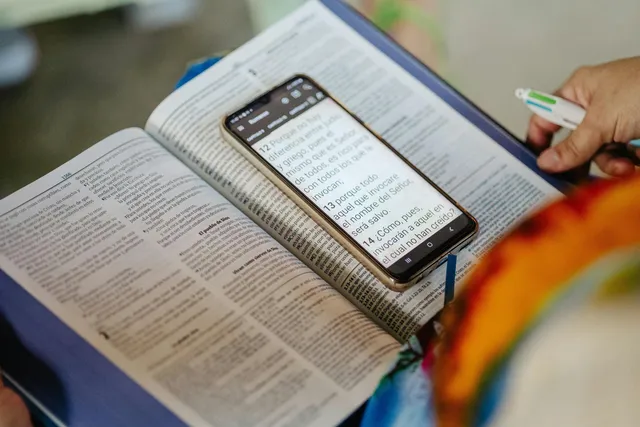
For centuries, believers have opened the pages of Scripture seeking the heart of God. We have studied, prayed, wrestled, and rejoiced over its mysteries. Now, a new question quietly stirs among Christian thinkers, pastors, and seekers alike: Can Artificial Intelligence - this rapidly advancing creation of human ingenuity - help us understand the Bible better? The question is not merely technological. It's deeply spiritual, touching on trust, discernment, and the ways God continues to reveal His truth to His people in every age.
The Ancient Word in a Digital Age
The Bible, that collection of sacred writings breathed by God and preserved through thousands of years, has always met new technologies. From the invention of the printing press to radio sermons, televised preaching, and now smartphone devotionals, the Word of God has journeyed through every communication revolution. Each era has brought both opportunities and challenges, yet the message of Scripture has never lost its power.
Perhaps, then, it should not surprise us that AI - a tool that can process language, trace themes, and find patterns hidden across thousands of verses - might become the next frontier. But what does that really mean for faith?
When Data Meets Divine Mystery
Imagine an AI reading the entire Bible in seconds - identifying every instance of mercy, tracing how hope appears through the prophets, or showing the linguistic progression of covenant from Genesis to Revelation. That's not science fiction anymore. AI-powered software can already perform such tasks. It can summarize passages, compare translations, and provide study notes faster than any concordance could dream.
Yet, even as we marvel at this ability, an important truth remains: speed is not the same as understanding. Knowledge is plentiful in the age of algorithms. But wisdom - the kind that transforms hearts and lives - still comes from the Holy Spirit. Technology can assist us, but it cannot replace divine Revelation.
The Difference Between Knowing and Hearing
There's a crucial distinction in the life of faith. We can know the words of Scripture intellectually, but until we hear God's voice speaking through them, the text remains ink on a page. Jesus rebuked the Pharisees for knowing the Scriptures yet missing the One to whom they pointed (John 5:39). AI may master textual analysis, but it cannot kneel in prayer. It cannot weep at the foot of the cross. It cannot experience grace.
Still, when guided by faithful men and women, AI might become a servant in our study. It can organize, highlight, and connect truths that lead us deeper into reflection. Like a lantern, it can light the path - but it is not the path itself.
AI as a Modern Scribe
Throughout history, God has invited people to use their creativity in service to His Word. Scribes copied Scripture by hand, inventors built printing presses, and translators risked everything to bring the Bible into new languages. Each generation found new ways to carry the ancient message forward.
Today, we might see AI as a kind of modern scribe - able to gather, sort, and present information in extraordinary ways. Scholars can use it to compare ancient manuscripts, detect historical language patterns, and even reconstruct lost grammatical nuances of Hebrew or Greek. Pastors might use AI to find cross-references or design small-group studies tailored to specific needs. Devotional writers can draw inspiration from datasets that show how certain virtues like hope or forgiveness permeate Scripture's storyline.
Used this way, AI becomes an instrument of stewardship rather than control. It extends human insight rather than replacing it. But here lies the delicate balance: tools must remain in the hands of the disciples, not become their teachers.
Guarding the Heart in an Age of Automation
There's a pastoral caution that must accompany this conversation. The danger of any new tool - from an app on our phone to a digital study Bible - is that it might make us feel like we're "doing spirituality" without actually meeting God. We scroll, we tap, we analyze... but do we pray?
Faith is not a data project. It's a relationship. And relationships require attention, silence, wonder, and surrender - things machines can never replicate. If we turn to AI merely to make Scripture "easier" or "more efficient," we risk losing the holy slowness by which the Spirit often speaks.
The Quiet Voice Still Calls
Elijah discovered that the Lord's voice was not in the wind, the earthquake, or the fire, but in a gentle whisper (1 Kings 19:11-12). Perhaps in our digital age, that whisper might call us to step away from the algorithm and simply listen again. AI might gather verses on peace, but only the Spirit can breathe that peace into our anxious hearts. The technology may point us to the words of Christ - but only Christ Himself can make those words come alive.
The Promise of Partnership
When viewed in balance, AI could enrich our study and even deepen outreach. Imagine missionaries using AI translation tools to bring Scripture to unreached languages faster than ever before. Envision pastors in small communities gaining access to advanced study resources they could never afford before. Think of believers around the world connecting over shared insights uncovered by digital tools that reveal the interconnected beauty of God's Word.
Such possibilities are already unfolding. In this sense, AI becomes a form of partnership - a means by which God's truth speeds ahead (2 Thessalonians 3:1). But partnership assumes faithfulness. We must continually measure these tools against Scripture, ensuring they serve its message rather than distort it.
Keeping Theology Human
One of the greatest temptations of modern technology is to let machines make meaning for us. Yet theology - the study of God - is never merely intellectual. It's personal, communal, and embodied. Jesus became flesh, not code. His disciples learned truth by walking with Him, not by downloading His teachings.
We must, then, use AI not to distance ourselves from Scripture, but to draw closer to it. If the tool helps us see patterns, may we respond with worship. If it highlights themes, may we meditate on them prayerfully. If it offers insight, may we test that insight in the community of faith.
The Spirit Still Leads
At the heart of Christian understanding is a profound promise: "When the Spirit of truth comes, He will guide you into all truth" (John 16:13). The Spirit does not need silicon processors or neural networks to fulfill that promise - but He can use human invention as another channel through which His light spreads. What matters is that our hearts remain open to His guidance.
The Spirit still leads. Through prayer, through study, through the gathered church, and yes, sometimes even through the tools we never imagined God could redeem. If we approach AI with humility and discernment, trusting God more than algorithms, perhaps we will find new ways to see the wonders already written before us.
Walking Forward with Wisdom
So, can AI help us understand the Bible better? The honest answer might be both yes and no. Yes - it can help us organize, explore, and connect the vast landscape of Scripture in astonishing ways. No - it cannot interpret our hearts, convict our souls, or reveal God's character. Only the living Word, made known by the Spirit, can do that.
In the days ahead, as believers experiment with these tools, let us remember that every technological advance remains under the lordship of Christ. He is not threatened by our inventions. Instead, He invites us to bring them into His service - purified by prayer, guided by Scripture, and motivated by love.
A Closing Reflection: The Word That Outlasts Every Algorithm
The Bible begins with God speaking light into darkness and ends with His promise to make all things new. Every algorithm, every screen, every tool we hold is a flicker within that vast story. The Word of God has endured empires, languages, revolutions - and it will outlast every update and innovation to come.
Perhaps the true gift of AI will not be that it understands the Bible better than we do, but that it awakens fresh wonder in us. That it reminds us just how miraculous this ancient text is - that generation after generation, God continues to meet His people through words written long ago yet alive today.
So let us explore fearlessly, study diligently, and trust deeply - knowing that no matter how advanced our tools become, the greatest Revelation will always be God Himself, speaking to the listening heart.