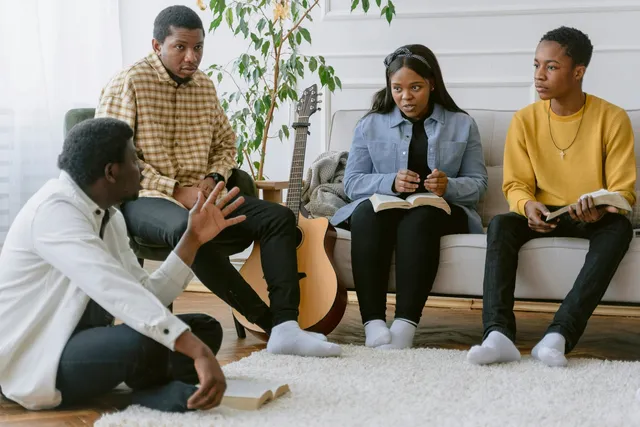
We often hear it said: "My faith is between me and God." On one level, that's true - our relationship with Christ is profoundly personal. Yet, the Bible never presents spiritual growth as a solitary journey. From Genesis to Revelation, faith unfolds in the context of community. We need one another, not merely for companionship, but for transformation.
The Myth of the Lone Believer
Our culture prizes independence. We celebrate the self-made man, the rugged individualist, the one who "needs no one." That mindset has, subtly and powerfully, crept into the spiritual life. Many believers assume that as long as they read Scripture, pray, and watch a sermon online, they're doing fine spiritually. But spiritual maturity is not an achievement we accomplish in isolation - it's a reality we grow into together.
Faith is personal but never private. Jesus calls us individually, yes, but then places us immediately within a body - His body. The Apostle Paul wrote, "Now you are the body of Christ, and each one of you is a part of it" (1 Corinthians 12:27). There's no category in Scripture for a dismembered limb growing in holiness apart from the rest of the body.
We Were Created for Connection
From the very beginning, God designed human flourishing around relationship. "It is not good for the man to be alone," God said in Genesis 2:18. This wasn't merely about marriage - it was a statement about the very fabric of the human soul. We are literally made in the image of a relational God - Father, Son, and Holy Spirit in eternal communion. To live isolated is to resist part of what it means to bear that image.
The Communion of the Trinity as Our Blueprint
Before time began, the Father loved the Son, and the Son delighted in the Father, and the Spirit flowed as the bond of perfect love between them. Relationship is not an accessory to God's nature; it is His nature. So when we pursue spiritual growth alone, we are attempting to imitate a relational God in an unrelational way. That simply can't work. The closer we draw to Him, the more deeply we are drawn toward others.
How Others Shape Us
It's often through people that God molds our hearts. Patience is not cultivated when life is easy and everyone agrees with us; it's taught when we must listen, forgive, and love the very ones who test us. Humility doesn't blossom in solitude - it's refined in community, where our rough edges meet the grace and friction of others' lives.
When the early believers in Acts shared all they had, prayed together daily, and broke bread from house to house (Acts 2:42-47), their faith deepened faster than isolation ever could produce. Their faith was lived, not lectured - shared, not shelved. God uses brothers and sisters, mentors, encouragers, and even difficult relationships to reveal the deeper work He wants to do in us.
The Mirror of Community
C.S. Lewis once wrote that friendship acts as a kind of spiritual mirror: our friends help us see the parts of ourselves we could never see alone. The same is true of the church. Fellowship exposes blind spots and softens pride. It also encourages when our own strength fades. A prayer whispered by a friend on our behalf can do more for our spirit than an hour of solitary striving.
We need voices outside our own to speak truth when we can't believe it for ourselves. That's not weakness; it's the humility Christ Himself modeled when He spent His earthly life among others - teaching, eating, weeping, rejoicing, never hiding Himself away for long.
The Church is God's Workshop
For some, "church" conjures images of buildings, programs, or Sunday routines. But Scripture paints it as a living organism, a people being shaped into Christ's likeness together. Paul called it "the household of God" (Ephesians 2:19). The church is not a passive audience; it's a spiritual workshop where grace is both received and practiced.
Within that workshop we stumble and forgive, we question and learn, we sing and cry. It's holy, but it's also messy - and that's precisely the point. God doesn't refine us in sterile conditions. The grind of community, under the guidance of love, becomes the very place where we are made holy.
Why the Mess Matters
When we're tempted to give up on the church because it feels imperfect, we forget: it has always been imperfect. The Corinthian church argued, the Galatian church fell into legalism, and even Peter needed correction from Paul. Yet God worked through them all. Our calling is not to find a flawless fellowship but to love faithfully within an imperfect one. The work of unity, perseverance, and grace we engage in there is precisely what grows our souls.
What We Miss When We're Alone
Isolation can feel safe. It spares us from being misunderstood, hurt, or challenged. But what we surrender in safety is depth. Like a coal separated from the fire, we cool faster when removed from the heat of shared faith. Worship sung among others stirs something in us that private devotion cannot replicate. Communion taken in solitude would lose its meaning - it is, by definition, a shared act of remembering together.
Even Jesus chose not to walk alone. He gathered twelve companions - imperfect ones - and journeyed with them. When He sent His followers into the world, He sent them out two by two. He could have chosen independence; instead, He modeled interdependence. That reveals much about what it means to live as His disciple.
Growing Together in the Everyday
Spiritual community isn't limited to Sunday gatherings. It's built in living rooms, in quiet coffees with a friend, in shared burdens and laughter. It's learning to let others pray for us when we cannot find the words; it's text messages that say, "I'm struggling today - can you lift me up?"; it's celebrating someone else's answered prayers as though they were our own.
Christian growth happens where ordinary life meets intentional love. Every believer needs spiritual companions - not perfect saints, but people who will walk alongside in authenticity, reminding us that grace is for today, too. In their presence, our stories intertwine with God's larger story of redemption.
Practices That Nurture Shared Growth
- Commit to vulnerability. Let others see where you truly are - joys, doubts, struggles alike. Openness invites grace to flourish.
- Pray together regularly. Shared prayer aligns hearts toward God and toward each other, forging intimacy that heals.
- Serve side by side. There is no faster way to bond than to pour out together for others in Christ's name.
- Seek reconciliation quickly. Don't let small wounds fester. The practice of forgiveness keeps the body healthy.
None of these are glamorous, but all are transformative. They form the rhythms of spiritual companionship that sustain us through seasons of both triumph and trial.
When Community Becomes a Witness
Jesus said, "By this everyone will know that you are my disciples, if you love one another" (John 13:35). The world does not see Christ most clearly through our arguments or achievements, but through our shared life of love. Each time we choose to stay connected, to forgive, to carry one another's burdens, we preach a living sermon: this is what God's love looks like in motion.
Community doesn't just grow us spiritually - it becomes a testimony that draws others to the faith. In an age marked by loneliness and division, a fellowship of genuine care becomes a radical and irresistible witness to the reality of Christ.
Together Toward the One Who Unites Us
Spiritual growth isn't about self-improvement; it's about participation in the life of Christ. And Christ always calls us closer - not only to Himself but to one another. As we walk with Him, we discover that we also walk with His people. We learn to see Him in their eyes, to hear Him in their words of encouragement, to feel His heart through their acts of kindness.
In the end, the path of faith is not a solitary climb but a pilgrimage of companions. We stumble, we rise, we sing, we pray, and through it all, we become a reflection of His grace - together. That's how the Spirit grows us: not as isolated trees, but as a flourishing forest rooted in love.
We can't grow spiritually alone, because God never meant us to. The more deeply we dwell in community, the more clearly we see Him - and the more beautifully He shines through us, united as one body in Christ Jesus.