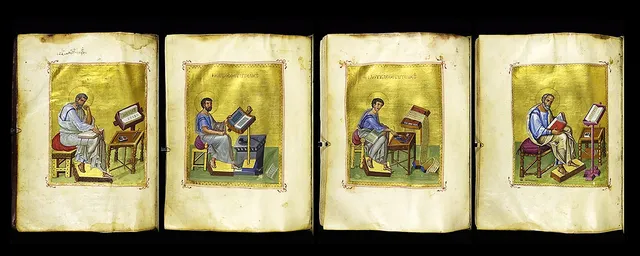
When we open the New Testament, the first pages greet us not with one continuous biography of Jesus but with four distinct yet harmonious portraits: Matthew, Mark, Luke, and John. Like four artists painting the same radiant subject from different angles, the Gospels each invite us to see Jesus afresh - not contradicting, but completing each other. We might ask, "Wouldn't one have been enough?" But God's wisdom chose four, and therein lies something profound about the nature of truth, testimony, and the mystery of Christ Himself.
Four Windows, One Light
Imagine stained glass in a cathedral, each panel depicting the same sun shining through in varied hues. That's how the Gospels work. The light is the same - Jesus Christ, the Son of God - yet the colors change with perspective, audience, and divine intention. Matthew, Mark, Luke, and John are not competitors; they are four spiritual windows framing one eternal Light.
From the earliest centuries, the Church has marveled at this fourfold witness. Early theologians even found symbolic meaning in the number four: echoing the four winds, four corners of the earth, four living creatures in Ezekiel's vision and Revelation's throne room. It's as though God wanted the story of His Son to go out to every direction of creation - to every heart under heaven.
Different Faces of the Same Savior
Each Gospel has its own flavor, its own heartbeat. Matthew writes for a Jewish audience steeped in the law and the prophets. His pages are heavy with the echo of the Old Testament, showing Jesus as the long-awaited Messiah who fulfills every promise. Mark, brief and energetic, moves swiftly - a Gospel of action. His favorite word seems to be "immediately," as if to capture the urgency of Christ's mission. Luke writes as the careful historian, but also as the compassionate physician, highlighting Jesus' tenderness toward the broken and the marginalized. John, the beloved disciple, writes last - not to repeat, but to reveal deeper layers of who Jesus is: the eternal Word made flesh, the Author of Life Himself.
Four voices, one harmony. Each gives us something essential that the others do not. To remove one would be to lose part of the melody God intended us to hear.
Matthew: The Gospel of Fulfillment
Matthew continually says, "This was to fulfill what was spoken by the prophet..." He draws a straight line from Abraham to Jesus, showing that God's promises never failed, even when centuries passed in silence. To Jewish readers wondering if this new Teacher from Nazareth truly belonged in God's story, Matthew answers: "Yes. He is the promised King." In tracing Jesus' genealogy, parables, and teachings - especially the Sermon on the Mount - Matthew paints a Savior deeply rooted in Scripture, yet bringing a new kingdom of the heart.
Mark: The Gospel of Power
Mark's account feels like a drumbeat - fast, vivid, visceral. Jesus strides across Galilee with authority: rebuking storms, commanding demons, restoring sight. Mark's purpose is not to give every detail, but to make us feel the electric immediacy of encountering the Son of God in motion. Some scholars believe Mark captured Peter's preaching; no wonder we feel the rawness of eyewitness memory. There's sweat and dust on these pages - and through it, the pulse of divine power.
Luke: The Gospel of Compassion
Luke gives us songs, stories, and heart. The Song of Songs of Mary, Zechariah, and Simeon only appear here. So do many parables that still shape our faith: the Good Samaritan, the Prodigal Son, the lost coin, the rich man and Lazarus. Luke wants us to see what grace looks like when it touches real lives. Outsiders, women, the poor, and sinners find welcome in Jesus' arms. Through Luke, we see not only God's might but His mercy.
John: The Gospel of Glory
Finally, John's Gospel invites us to look past the surface and behold the eternal. "In the beginning was the Word, and the Word was with God, and the Word was God." John sees Jesus not simply as a teacher or prophet but as God's own self-Revelation - the eternal Logos who became flesh for us. His seven signs and profound conversations (with Nicodemus, the Samaritan woman, Pilate, and others) draw us into the question of identity itself: "Who is Jesus?" And John answers with luminous simplicity - He is Life, Light, and Love.
Four Gospels, Not Four Stories
Sometimes critics point out the differences among the Gospels - variations in order, detail, or wording. But those differences are not contradictions; they are complements. The Gospels were never meant to be identical news reports. They are testimonies of faith rooted in truth, seen through the eyes of witnesses who were moved by the Holy Spirit. Just as four people might describe the same sunrise in unique words, the fullness of the experience is grasped only by hearing all four.
In legal terms, multiple witnesses strengthen a case. Their convergence from different perspectives shows authenticity, not fabrication. How fitting, then, that the greatest story ever told would come with four credible, Spirit-inspired accounts.
The Gospel as Relationship, Not Just Record
God could have given us a single, streamlined biography - a chronological scroll that leaves no ambiguity. Yet He chose instead to give us a conversation across four voices. Why? Because He desires relationship, not mere information. Each Gospel calls out to different hearts and minds, engaging our imagination, intellect, and emotion in different ways. The goal isn't just that we know facts about Jesus, but that we come to know Him.
Matthew resonates when we long for roots and fulfillment. Mark speaks to those craving action and conviction. Luke comforts the tender-hearted and the weary. John enthralls those yearning for mystery and intimacy with God. Together they gather us all, showing that the Savior belongs to everyone - the scholar, the seeker, the sufferer, the saint.
The Divine Symphony of Perspective
Perhaps we could think of it like music. A single instrument can carry a melody, but when four play together - each with their own tone - the Song of Songs becomes full and dimensional. The four Gospels together form God's great symphony of salvation, and the Holy Spirit is the Conductor ensuring harmony. Where one finds detail, another brings depth. Where one speaks of miracle, another reveals motive. Together, they give us not just what Jesus did, but who He is and why it matters.
A Unity That Mirrors the Trinity
Isn't it beautiful that even the Gospel record itself mirrors something of God's own nature? One truth, revealed in three Persons - and one Savior, revealed through four testimonies. The unity-in-diversity of the Gospels whispers to us about the heart of the divine: God loves multiplicity of expression yet remains perfectly one.
For the Church and the World
The practical wisdom of four Gospels is seen in how they shaped the early Church. Different communities were at different stages of faith. Jewish believers wrestled with how Christ fulfilled the law; Gentile converts needed assurance they belonged. Some needed to see the power of miracles; others the tenderness of mercy; still others the eternal nature of the Word. The Holy Spirit, knowing every human heart, crafted a witness that could feed all of them.
And still today, people come to faith through different doors. Some read Matthew and see the long thread of prophecy fulfilled. Others glimpse themselves in Luke's characters - sinners found and forgiven. Others meet Jesus in the poetic depth of John and fall in love with His person. The four Gospels are God's way of making sure no honest seeker is left without a path home.
Why Not One? Because We Need All Four
We live in an age that prizes simplification and summary. "Give me the TL;DR," we say - the short version. But spiritual truth resists reduction. The Gospel cannot be compressed without losing its heartbeat. We need all four voices to understand the magnificent complexity of the God who became man, lived among us, died, and rose again.
When we read only one Gospel, we catch a glimpse; when we read all four, we behold a Person. It's like walking around a sculpture instead of looking at a photograph. Every viewpoint reveals contours we hadn't seen, and the whole becomes breathtaking.
Living the Fourfold Gospel Today
In our own journey of discipleship, the four Gospels also model how to live and witness. There's Matthew's faithfulness to Scripture, Mark's urgency to act, Luke's compassion for all people, and John's devotion to intimacy with Christ. If our spiritual lives reflected all four sides, how balanced would we be? Sometimes we lean too much toward study without heart, or action without prayer. The Gospels remind us that Jesus is both Teacher and Healer, servant and Lord, lamb and lion - and that following Him means embracing all those dimensions, not just the ones that suit us.
Reading Them Together
A fruitful practice for disciples today is to read the Gospels in parallel - not hunting for discrepancies, but watching how the Spirit weaves their voices together. Notice how Matthew stresses obedience, Mark action, Luke compassion, John worship. Then ask, "What might the Lord be emphasizing to me in this season of my life?"
When Scripture becomes personal encounter instead of mere study, it transforms. That's the secret power of the fourfold Gospel: it doesn't just tell us what happened; it draws us into what is still happening - Christ alive and active in every heart that believes.
The Story Big Enough for the World
The fourfold Gospel also reminds us that God's story is bigger than any one culture, language, or century. This message was meant to span the earth - the Messiah of Israel who blesses the nations, the Word through whom all things were made, now dwelling among us. The universality of the Gospel is mirrored in its diversity of expression. No one voice could say it all; all were needed to echo eternity.
When we share the Gospel today, whether through spoken word, service, art, or compassion, we join that divine pattern - one story, many tellings, one Lord. Each of us becomes, in a sense, a living page in that continuing testimony.
The Beauty of a Multifaceted Christ
Why four Gospels? Because love is too vast for a single angle. Because the fullness of divine mystery required more than a monologue - it called for a chorus. In reading Matthew, Mark, Luke, and John, we do not meet four Christs, but one Lord who meets us through four sacred doorways. And as we step through each one, we are changed.
The fourfold Gospel invites us into a fuller relationship with Jesus, where knowledge meets wonder and faith meets love. It reminds us that God's truth can be both unified and varied, orderly and alive. So the next time we open those pages, let's not rush to compare or summarize. Let's listen, linger, and let the symphony play. For in the harmony of four voices, Heaven still sings one Song of Songs - Christ, our Savior, the Light of the world.