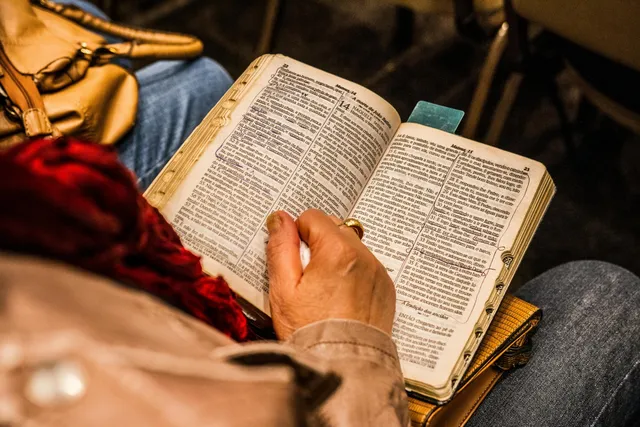
In every generation, God raises up men and women who seek Him not only with passion but also with understanding. Too often we imagine faith and learning as opposites-one emotional, the other cerebral. Yet the heroes of Scripture tell another story: the pursuit of knowledge is not a worldly distraction, but a sacred calling. The Bible's most faithful servants were also its most curious learners, men and women who cultivated wisdom, sought counsel, studied creation, and allowed truth to shape their obedience.
The Heart of a Learner
From the opening chapters of Proverbs, Scripture invites us to hear wisdom calling in the streets. "Get wisdom, get understanding; do not forget my words or turn away from them" (Proverbs 4:5). Learning, in the biblical sense, is not abstract-it's relational. We learn not to master facts but to know the Father. Every hero in the faith, in one way or another, showed this hunger to grow in knowledge that honors God.
Spiritual maturity is inseparable from intellectual humility. The fear of the Lord, which Proverbs calls the beginning of knowledge, is as much about posture as it is about perspective. It's the stance of someone who realizes that all truth, wisdom, and understanding flow from the Creator. For the biblical hero, learning is worship with the mind, a form of surrender that says, "Lord, teach me Your ways."
Moses: The Scholar in the Wilderness
Moses may be better remembered as the lawgiver or deliverer, yet the story of his life reveals a deep pattern of continual learning. Raised in Pharaoh's household, he was undoubtedly immersed in the highest education Egypt could offer-mathematics, languages, leadership, and possibly even philosophy. But those early lessons were only a prelude to the education of the desert, where God would teach him true wisdom.
Long before he ever led a nation, Moses spent forty years learning the humility of obscurity, tending sheep for his father-in-law. God often teaches His greatest truths in seasons the world calls wasted. When the burning bush blazed before him, Moses was ready-not because he had mastered theology, but because he had learned to listen. His curiosity drew him closer: "I will now turn aside and see this great sight" (Exodus 3:3). That turning aside-the willingness to seek, to ask, to learn-became the defining mark of his faith.
The Learning Leader
Even after leading Israel out of Egypt, Moses remained a student of God. He climbed Sinai again and again, fasting, praying, receiving instruction. When he didn't understand, he asked questions. When he failed, he sought to learn from the Lord's rebuke. His hunger for understanding culminated in his cry, "Teach me Your ways, that I may know You" (Exodus 33:13). That is the heartbeat of every learner who walks with God.
Daniel: Wisdom in a Foreign Land
No biblical figure captures the marriage of faith and intellect quite like Daniel. Exiled as a young man into Babylon, Daniel's education was steeped in the literature and science of his captors. Yet, rather than rejecting learning, he consecrated it. The book of Daniel tells us that God gave him "knowledge and skill in all learning and wisdom" (Daniel 1:17). Daniel's mind became a vessel for divine Revelation precisely because his heart was anchored in faithfulness.
True learning does not dilute faith-it deepens it when it remains surrendered to God. Daniel studied within a pagan system, but he never became a pagan. He learned the structures of empire, the rhythms of astronomy, the politics of kings-yet he filtered everything through his devotion to Yahweh. When the time came to interpret Nebuchadnezzar's dreams, Daniel's intellectual preparation met divine inspiration, producing wisdom that astonished a kingdom.
Learning as Resistance
For Daniel, learning was an act of quiet resistance. His understanding gave him influence in courts hostile to his beliefs, allowing him to speak truth where others were silenced. His life shows that God's people don't have to flee from knowledge. Instead, they can redeem it, reframing it under the sovereignty of the Creator.
In our own day, when culture often pits faith against education, Daniel reminds us to hold the line: to study, to discern, to seek excellence-not to earn prestige, but to demonstrate that all wisdom belongs to God.
Mary of Bethany: The Disciple Who Chose the Better Part
It's easy to overlook, but one of the most profound pictures of learning in Scripture comes from a small village home in Bethany. Martha bustled with hospitality; Mary sat at Jesus' feet and listened. In that ancient world, such a posture was reserved for disciples-students under a rabbi's instruction. By choosing to sit and learn, Mary broke social expectations to pursue spiritual understanding.
When Jesus commended her, saying she had chosen the better part, He affirmed that the pursuit of divine knowledge was not reserved for scholars or priests but open to anyone hungry for His words. Later, at Lazarus's tomb, her trust in Christ's identity revealed how much she had learned from Him-not just information, but Revelation.
Learning as Love
Mary's story teaches us that learning is an expression of love. To learn from Jesus is to lean into His presence, to crave His voice more than the noise of the world. In our own distracted age, sitting at the feet of Christ can be the most countercultural act of all.
Solomon: The Wisdom Seeker
If Moses was the practical learner and Daniel the intellectual, Solomon stands as the philosopher-king, a man who asked God for understanding above all else. "Give your servant a discerning heart to govern your people and to distinguish between right and wrong" (1 Kings 3:9). That request pleased the Lord, who granted him not only wisdom but honor and prosperity.
Solomon's wisdom became legendary. Foreign rulers came from afar to hear his insights on everything from politics to plants. Yet his story carries both encouragement and warning. He reminds us that wisdom, once received, must continually be nourished by obedience. Learning without humility drifts into pride; understanding without devotion decays into emptiness.
Ecclesiastes: The Learner's Lament
In his later years, Solomon's reflections in Ecclesiastes reveal a man who had tasted every kind of knowledge yet rediscovered that only the fear of the Lord endures. That confession doesn't diminish learning-it redeems it. It teaches us that knowledge is not an end, but a means to deeper reverence. Every book studied, every insight gained, points back to the One who is the source of all wisdom.
Paul the Apostle: Redeemed Intellect
Saul of Tarsus was among the most educated men of his era, trained under the esteemed rabbi Gamaliel. He knew the Scriptures across languages and traditions, skilled in law, logic, and rhetoric. Yet, on the road to Damascus, all that learning collided with the living Christ. The result was not the destruction of intellect, but its redemption. The same mind that once persecuted believers became a powerful instrument for explaining the mysteries of grace.
In Paul's letters, we see a relentless learner humbled by Revelation. He studied culture to communicate the gospel effectively, quoting poets in Athens and reasoning in synagogues with precision. His command of Scripture allowed him to reveal Christ in every prophecy and promise. For Paul, learning became mission fuel. Every insight was harnessed to make Christ known more clearly, more convincingly, to more people.
The Mind Renewed
When Paul urged believers to be "transformed by the renewing of your mind" (Romans 12:2), he wasn't merely calling for moral change. He was inviting us into intellectual and spiritual renewal-a pattern of continual learning under the Spirit's guidance. In Paul's vision, the Christian life is a lifelong education in the grace of God, where the mind is shaped not by the world's logic but by the wisdom of Christ.
Jesus: The Perfect Learner
It may sound surprising, but even Jesus, in His humanity, is described in Luke 2:52 as one who "grew in wisdom and stature, and in favor with God and man." The Son of God did not bypass the learning process. As a boy in the temple, He sat among the teachers, listening and asking questions. That scene captures the divine affirmation of curiosity: to ask questions is not doubt-it's devotion in motion.
Jesus dignified the learning process itself. His parables drew from nature, history, and human experience. His teachings engaged both heart and intellect. He modeled how divine truth can inhabit common understanding, transforming ordinary observations into spiritual Revelation. In Him, the pursuit of knowledge found its perfect harmony with the will of God.
Learning as a Sacred Calling Today
From Moses in the wilderness to Mary at Jesus' feet, each hero we've considered teaches that learning is a spiritual act. It requires humility, patience, curiosity, and above all, dependence on God. In our age of information overload, the biblical vision of learning is not to know everything, but to know Him above all.
Christians today are called to cultivate holy curiosity. Whether studying theology, science, art, or the daily lessons of work and family, every act of learning becomes sacred when offered to God. Like Daniel, we can excel in our studies while staying faithful to our witness. Like Mary, we can pause our busyness to sit and listen. Like Paul, we can let every new insight propel us into deeper mission.
A Prayer for the Learning Heart
May we be people who ask questions-not out of skepticism, but out of hunger for truth. May we walk through life as students of the Spirit, letting every season, every relationship, every challenge become a classroom of grace. May we remember that wisdom is more than intelligence-it's intimacy with the Lord who teaches us, day by day, to live as reflections of His light.
Learning as Worship
Learning, in its truest form, is worship. Each new truth discovered, each word of Scripture understood, each insight received through prayer or study becomes an offering laid before the One who knows all things. To be a biblical hero is not to have all the answers, but to love the process of seeking them in God's presence. The same Spirit who inspired the prophets and apostles still whispers today: "Come, learn of Me."
As we obey that invitation, our faith grows deeper, our love richer, and our witness stronger. In the end, the greatest learners in Scripture-and in our own time-are those whose minds are open because their hearts are surrendered. May that be said of us: disciples whose faith thinks, and whose minds worship.