It usually happens in February or March. The enrollment forms come out, the charter school lottery closes, the homeschool co-op posts its fall schedule, and a Christian family sits at the kitchen table after the kids are in bed trying to decide something that feels far too large for a Tuesday night. One parent has read an article about what's being taught in the local middle school. The other remembers a friend from church whose homeschooled kids seemed lonely. There's the tuition at the Christian academy, which would mean no vacation for three years and possibly a second job. And underneath all of it sits a quieter fear, the one nobody says out loud: What if we pick wrong and our child walks away from the faith because of it?
That fear deserves to be taken seriously, and then it deserves to be answered. Because Scripture has a great deal to say about the education of children, and almost none of it is about buildings, curricula, or institutions. What the Bible gives us is something both heavier and more freeing: a clear assignment, a wide field of wisdom, and a strong warning against turning our own convictions into law for everyone else.
What Deuteronomy 6 Actually Says
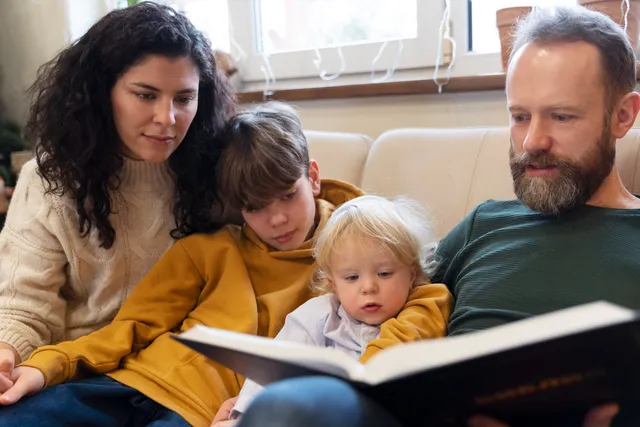
Nearly every conversation about Christian education eventually lands on Deuteronomy 6, and for good reason. Moses is speaking to a generation on the edge of the Promised Land, and after giving them the Shema, "Hear, O Israel: The LORD our God, the LORD is one," he tells them what to do with it. "You shall teach them diligently to your children, and shall talk of them when you sit in your house, and when you walk by the way, and when you lie down, and when you rise" (Deuteronomy 6:7).
Notice what that verse assumes. It assumes a home where conversation happens. It assumes parents who know the Word well enough to talk about it without a lesson plan. It assumes that spiritual formation is not a subject slotted into a schedule but a running commentary on ordinary life: walking, sitting, lying down, getting up. The Hebrew word often rendered "teach diligently" carries the sense of repeating, of sharpening by repetition, the way you'd whet a blade. It is daily, unglamorous, cumulative work.
What the passage does not do is name an institution. There is no school in Deuteronomy 6. There is no curriculum, no building, no teacher with a credential. The command is not about where your child sits from eight to three, but about who is responsible for forming their soul, and the answer is you. Israel's children would learn trades, letters, and farming in all sorts of settings. But the covenant, the story, the character of God: that was the family's charge, reinforced by the worshiping community around them.
This matters enormously for the kitchen table conversation, because it moves the decisive question. The question is not primarily "which school will disciple my child?" It is "how will we disciple our child, and which schooling arrangement best supports that work in this season, for this child, with the resources we actually have?" Those are different questions, and the second one is answerable.
The Responsibility Does Not Transfer
Here is where every option carries the same risk, just dressed differently.
Parents who choose a Christian school can quietly outsource. The school opens in prayer, teaches Bible as a graded subject, requires chapel, and sends home a doctrinal statement. It is easy to assume the job is covered. But a child can memorize the books of the Bible, ace a theology quiz, and never once hear his father talk honestly about his own sin and his own need for Christ. Paul tells fathers to bring their children up "in the discipline and instruction of the Lord" (Ephesians 6:4). He does not say to enroll them in it.
Parents who homeschool can assume that proximity equals formation. Being together all day is a genuine gift, but hours in the same house do not automatically produce a discipled heart. A homeschool can become every bit as mechanical as any classroom, with Bible reduced to copywork and the mother too exhausted by lesson prep to have the long, unhurried conversation her fourteen year old is circling around at ten at night. Some of the most spiritually hungry young adults I have met were homeschooled in homes where the academics were rigorous and the faith was assumed.
And parents who choose public school can tell themselves that church and youth group will handle the spiritual side. Two hours a week against thirty five is not a fair fight, and it was never meant to be one. The church exists to equip the saints for ministry, including the ministry a parent does at breakfast.
In every case the same truth holds. No school, however good, can inherit a parent's calling. Which means the first decision is not where to enroll but whether you are willing to do the slow work of Deuteronomy 6 regardless of the answer.
Salt, Light, and the Question of Readiness
Jesus told his disciples, "You are the salt of the earth" and "You are the light of the world" (Matthew 5:13-14), and this is often invoked as a reason to put Christian children in public schools. There is real weight to it. Jesus prayed for his followers not that the Father would "take them out of the world" but that he would "keep them from the evil one" (John 17:15). Christian faith has never been a hothouse religion. Daniel and his friends were educated in the literature and language of Babylon, trained for the service of a pagan king, and they emerged with their convictions intact and their usefulness sharpened.
But the Daniel comparison cuts both ways, and honest advocates of public schooling should admit it. Daniel arrives in Babylon as a young man, already formed by years in a covenant household, already possessing the settled conviction that let him resolve "that he would not defile himself" (Daniel 1:8). He was sent in, not raised there from infancy. A seven year old is not a missionary in the sense an adult is. Children are learners by nature and designed to absorb what surrounds them, which is precisely why Proverbs spends so much energy on who a young person spends time with.
So salt and light is a genuine biblical consideration, but it functions as wisdom, not as a command binding every family. Some children are, at some ages, ready to stand in environments that would swamp others. Some are not. Parents who know their child's temperament, their current spiritual appetite, and the actual character of the local school are in a far better position to judge that than any writer, podcaster, or conference speaker. Protection and engagement are not rival philosophies. They are two things a loving parent does in different measures at different ages, the way you hold a toddler's hand near traffic and later teach a sixteen year old to drive.
Where Conscience Comes In
Romans 14 was written about food and holy days, but the principle reaches much further. Paul addresses believers who have come to genuinely different convictions about matters Scripture has not settled, and his counsel is remarkable: "Let each one be fully convinced in his own mind" (Romans 14:5). Not indifferent. Not casual. Convinced. And then, crucially, "Who are you to pass judgment on the servant of another? It is before his own master that he stands or falls" (Romans 14:4).
Schooling is a conscience issue in exactly this sense. The Bible commands the discipleship of children with total clarity and leaves the method of their arithmetic instruction entirely open. That is not a gap in Revelation. It is God's deliberate entrusting of real judgment to real parents in real circumstances, which differ wildly. A family in a rural district with a caring, well run school is not facing the same decision as a family in a district where the school is genuinely unsafe. A single mother working two jobs does not have the homeschool option that a two parent household with flexible income has. A child with significant learning needs may thrive with services that only a public school can fund.
Paul's instruction cuts in two directions at once, and most of us only remember the direction that flatters us. It means you should think hard and arrive at a real conviction rather than drifting. It also means that your conviction, however hard won, is binding on you and not on the family in the next pew. A conscience is a compass for your own household, not a measuring stick for anyone else's.
The Judgment Problem
If you have been in church circles for any length of time, you have felt the temperature in the room shift when school comes up. The homeschooling mother who hears "but what about socialization?" for the hundredth time. The public school father who catches the pause before someone says "oh, that's great" in a tone that means something else. The couple whose Christian school tuition prompts a comment about priorities and stewardship.
Much of this is insecurity wearing theology as a costume. We are all making enormous decisions with incomplete information about children we love more than our own lives, and the surest way to quiet the doubt is to find someone who chose differently and conclude they chose worse. It is cheap comfort, and it poisons the one community most capable of helping us.
James warns that "with the tongue we bless our Lord and Father, and with it we curse people who are made in the likeness of God" (James 3:9), and few arenas prove him right faster than school talk among Christian parents. The corrective is not polite silence. It is actual curiosity. Ask the homeschooling family what their hardest subject has been this year. Ask the public school family how their daughter's friendships are going and whether anything has come up that they are working through together. Ask the Christian school family what they wish were different. You will find, almost every time, parents who prayed, weighed, and sacrificed, and who carry the same two in the morning fear you do.
Deciding Well, and Then Holding It Loosely
Practically, a few things tend to clarify the choice. Know the actual school rather than the rumor of it, which means visiting, meeting teachers, and talking to families already there. Know your particular child, since siblings in the same home often need different things. Count the cost honestly, including the cost to a marriage or a mother's health that a stretched arrangement may impose, because a sustainable good is better than an unsustainable ideal. Seek counsel from people who know your family rather than from the internet's loudest voices, remembering that "in an abundance of counselors there is safety" (Proverbs 11:14). And pray with the expectation that God gives wisdom generously "without reproach" (James 1:5) to parents who ask.
Then hold the decision loosely enough to revisit it. School choice is not a sacrament. Families move, children change, schools change, finances change. Many faithful households have homeschooled for the elementary years and sent their teenagers to public high school, or the reverse. Reversing course is not failure. It is parenting.
The Part You Can Actually Control
Whatever you decide this spring, something will remain entirely in your hands, and it is the part Deuteronomy 6 was always talking about. Dinner together, most nights, with the phones somewhere else. The willingness to answer the awkward question your child asks in the car instead of deflecting it. A short Scripture reading that your family can sustain for a decade rather than an ambitious one that collapses in April. Confessing to your children when you lose your temper, so they learn what repentance sounds like from someone they love. Praying for them by name, out loud, where they can hear you.
Those practices will shape a child more deeply than any institution, and they are available to every family in every arrangement, at any income level, in any district. The schooling question is worth your prayer and your careful thought. But the children of God have been raised faithfully in Babylon and lost in the most sheltered of homes, and the difference has rarely been the building. It has been whether, when they sat in the house and walked by the way, somebody who loved them talked about the Lord as though he were real.