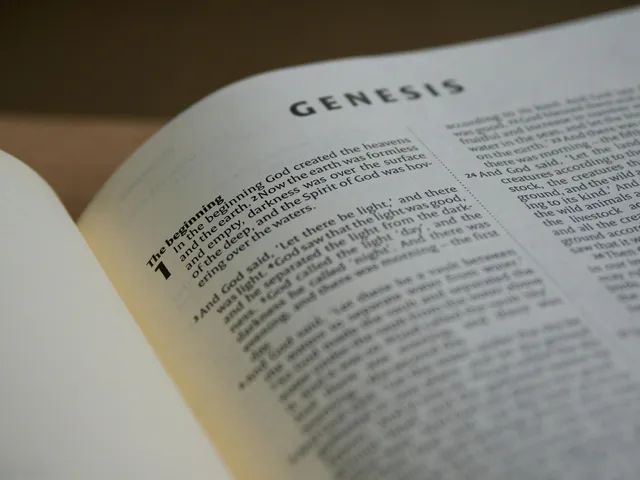
Few questions stir as much reflection - and sometimes tension - among Christians as the one surrounding how life began. Was it creation in the literal sense, as Genesis describes in its poetic opening verses, or did God use the process of evolution as the mechanism of His creation? This question doesn't just touch on science or theology; it reaches deep into how believers perceive God's character, the nature of faith, and what it means to live as His image-bearers in a complex world.
The Genesis of Belief
For centuries, Christians have turned to the first chapters of Genesis as the foundational story of human origins: that God created the heavens and the earth, and that humanity was formed lovingly by His hands and animated by His breath. These verses are not cold scientific claims - they are declarations of relationship, meaning, and divine purpose.
Genesis 1 is majestic in its rhythm: light, life, order, and goodness. It tells us that God is not a distant architect but an intimate craftsman who speaks creation into existence and calls it good. Whether we view those six days as literal 24-hour periods or as symbolic epochs, the heart of the text remains unchanged: the universe was not born of chaos, but of love.
Creationism: The Simplicity and Strength of Trust
Many Christians hold firmly to a literal reading of Scripture, believing that God created the world in six actual days, just as Genesis 1 records. This view, often called "Young Earth Creationism," insists that Scripture is clear and trustworthy - and that human understanding must bow to divine Revelation.
For these believers, the act of creation speaks not just to how the world began, but to who God is: sovereign, powerful, and purposeful. They see in the Genesis account a direct testimony of God's authority. They read passages like Psalms 33:6 - "By the word of the Lord the heavens were made, their starry host by the breath of his mouth" - as not metaphorical but profoundly real.
There is a beauty in such faith. It reminds us that God does not need to prove Himself by our categories of evidence. He speaks, and it is so. This outlook emphasizes a childlike trust in God's Word - a trust echoed by Jesus Himself when He said, "Unless you become like little children, you will never enter the kingdom of heaven."
Evolutionary Creation: God Through the Long Story
Other Christians, equally devoted to Scripture and prayer, find that God's Word and God's world tell a story in harmony. They embrace what is known as theistic evolution or evolutionary creation - the belief that evolution is the method by which God created life over vast spans of time.
This view doesn't see evolution as a replacement for God, but as a ribbon tracing His creative artistry through history. These believers look up at the night sky, gaze at the fossil layers, observe the intricate code of DNA, and say, "My God did this - through time, through diversity, through beauty."
They interpret Genesis as a theological text, not a scientific manual. The focus, in their eyes, is not on calendars and sequences but on meaning and relationship. The Bible tells us who made the world, not merely how. Science can explore mechanisms; only Scripture reveals motive, heart, and divine intent.
Faith That Embraces Mystery
For those who hold this view, faith means living comfortably within uncertainty. It's the ability to say, as Job told God, "I know that you can do all things; no purpose of yours can be thwarted." Evolutionary creationists see in both the Bible and biology a shared testimony: creation is still unfolding, and its Maker is endlessly faithful.
The Common Ground of Wonder
Despite different interpretations, there is something profoundly unifying among Christians who ponder these questions. Whether one envisions a young earth, an ancient cosmos, or something in between, all can agree that creation reflects God's glory.
Psalms 19 captures it perfectly: "The heavens declare the glory of God; the skies proclaim the work of his hands." That declaration is not bound to a timeline. It whispers in every star and sings in every cell. The story of the cosmos is, ultimately, a story of praise.
Perhaps the important question is not whether creation happened in six days or over six billion years, but whether we can still be awed by the fact that it happened at all - that we are loved by the One who imagined galaxies and yet numbers the very hairs on our heads.
When Belief Meets Science
Discussions about origin often stir debate not because of what the Bible says, but because of how we read it in a scientific age. Some Christians worry that accepting scientific theories may weaken faith. Others believe that ignoring scientific discovery can limit the scope of our wonder.
Yet if all truth is God's truth, then honest exploration - whether through microscopes or Scripture - leads us back to Him. The tension between creation and evolution can become, instead of a battlefield, a sacred meeting ground where humility thrives. We realize that both the theologian and the biologist are in their own ways tracing fingerprints of the same Creator.
Lessons from Church History
This isn't a new tension. When early Christians encountered the astronomy of their time, many wrestled with how to understand the sun, moon, and stars in light of Scripture. Later, during the Renaissance, the Church faced the discoveries of Galileo and Copernicus. Over centuries, faith has learned to dialogue with discovery. And each time, believers have rediscovered that truth does not fear investigation.
The heart of the Christian faith has never been about defending one scientific model or another; it has always been about trusting the Creator personally. "In the beginning God created" remains both the first line of Scripture and the first confession of hope.
What Matters Most: The Imago Dei
Regardless of the model one holds, all Christians affirm something sacred: that humankind was created in the image of God - the Imago Dei (Genesis 1:27). This truth grounds our dignity, our morality, and our calling to love and care for creation.
Whether God formed Adam from dust in a moment or brought humanity forth through divine process, the outcome is the same: we bear His likeness. We think, we create, we love, and we carry in our hearts a hunger for eternity. The evolutionary mechanism, if it happened, did not rob us of that identity; in fact, for some believers, it magnifies the miracle that through billions of years and across the tapestry of life, God was shaping someone in His own image.
A Call to Humility and Worship
What does all of this mean for us in day-to-day life? It means that the discussion of creation vs. evolution should lead not to prideful division but to worshipful humility. Paul reminded the Corinthians that "we know in part." Our understanding is always partial, but our faith can be whole.
When we look at the sunrise and whisper "Thank You," when we protect the planet as stewards of God's garden, when we delight in a child's curiosity - we are living out the heart of Genesis. Creation is not only what God did long ago; it's what He invites us into every day.
Belief, after all, is not a chart to defend, but a Song of Songs to sing.
Living Between Wonder and Trust
Maybe the healthiest posture for modern Christians is to hold both Scripture and science as gifts - distinct but not opposed. The Bible tells us why the universe exists; science may help us glimpse how it unfolds. And perhaps both, if we listen closely, echo with the same refrain: God is still speaking through His creation.
When we realize this, the question "Creation or evolution?" becomes less of a dividing line and more of an invitation - an invitation to wonder, to humility, and to deeper worship. The same Spirit that hovered over the waters in Genesis hovers still, stirring hearts toward truth and awe.
Standing in the Sacred Middle
Whether you stand firm on a literal six-day creation or see the beauty of a long evolutionary process guided by God's hand, remember this: faith and science both begin with the same impulse - curiosity about God's world. And both, when pursued in love, lead us to bow before His greatness.
As Christians, our calling is not to win arguments but to bear witness. Creation's story - however we understand it - calls us to gratitude, stewardship, and reverence. Every sunrise, every mountain, every cell, every heartbeat whispers that the world is not an accident. It is grace spoken into being.
May we live as people of both conviction and curiosity, holding in one hand the Scriptures and in the other the wonder of discovery - both pointing, always, toward the same Creator who said, "Let there be light," and then gave us eyes to see it.