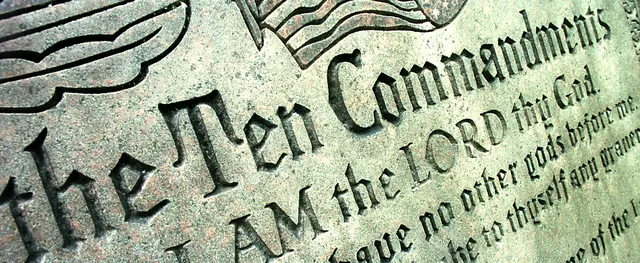
The smoke of Sinai still rises across the centuries. Thunder, lightning, and a trembling mountain-these scenes from Exodus 20 have a way of echoing in the human heart. God's voice declared words not just for an ancient people encamped in the wilderness, but for every generation that has come after. The Ten Commandments stand as both a mirror and a map: revealing who we are, and showing us who we're called to be. In a world chasing autonomy and self-expression, these commands whisper a different freedom-the freedom of living in rhythm with God.
Encountering the Voice That Still Speaks
Before a single command was given, something remarkable happened: God introduced Himself. "I am the LORD your God, who brought you out of Egypt." The gospel pulse beats right from the start-grace precedes law. The people had already been rescued before being given rules. Our obedience today flows from the same truth. Christ has delivered us, and in gratitude, we now learn how to walk in His ways. Divine commands are always born from divine kindness.
No Other Gods: The Invitation to Exclusive Love
The first commandment is not a restriction as much as a romance. "You shall have no other gods before Me." It's as if God says, "Your full heart-I want that." The call to worship Him alone stands in rebellion against every idol of our age: money, success, pleasure, influence. These aren't carved statues, but they demand sacrifice just the same. To keep this command today is to continually return to our first love, choosing to let nothing compete with the center that belongs only to God.
The Dangers of Our Own Making
Modern Idols and Quiet Temples
The second commandment forbids making images, yet idolatry rarely wears ancient clothes. The modern heart manufactures subtler idols-perhaps the ideal self we curate online, or the level of achievement that defines our identity. Whenever we reduce God to a manageable shape, we lose His mystery. The commandment calls us back to awe: to worship not our reflections, but the living, ungraspable Creator. In an image-saturated world, this is countercultural holiness-to resist creating a God who looks like us, and instead be reshaped into His likeness.
The Name: More Than Words
"You shall not take the name of the LORD your God in vain." This command is about far more than careless or crude speech. It's about carrying the name well. If we call ourselves Christians, we bear His identity in every interaction, every promise we make, every post we share. To misuse His name is not just to swear-it's to live inconsistently with the character we profess. Every time we act with integrity, compassion, and truth, we honor His name. The world learns what God is like through how His people bear His reputation.
Rest and Reverence
Then comes the gift wrapped as a command: "Remember the Sabbath day." The word "remember" is tender-it assumes we might forget. God invited His people to rest not because He needed it, but because they did. In the hurry of today's culture, Sabbath is a radical confession that we are not in control, that the world can turn without our constant motion. Rest is resistance to the tyranny of productivity. It says, "My worth is not in what I accomplish, but in who I belong to." Sabbath restores rhythm to our souls and reorients us toward worship.
A Spirit of Sabbath
While Christians debate how Sabbath applies under the new covenant, the heart of the principle remains vital. When Jesus declared Himself "Lord of the Sabbath," He didn't abolish rest-He fulfilled it. In Him we find ultimate rest for our souls (Matthew 11:28-30). Setting aside time for worship, renewal, and community becomes a way of receiving His gift anew each week.
Honoring the Ones Who Shaped Us
The fifth commandment-"Honor your father and mother"-bridges heaven and earth. It links the love of God with the love of neighbor, shaping society through family. Honor does not always mean agreement, especially when relationships have been wounded or complex. But it does mean recognizing the image of God in our parents, showing respect, forgiveness, and care where possible. To honor is to participate in God's life-giving order. In an age that prizes independence, this command whispers of rootedness, gratitude, and continuity of faith across generations.
Life's Sacredness: The Command to Protect
"You shall not murder." These brief words affirm an expansive truth: Life is sacred because God breathes it. Every human being bears His image-from the unborn to the aged, the stranger to the friend. To obey this command is not just to avoid taking life, but to cherish and defend it, to cultivate a heart free from hatred or indifference. Jesus deepened this in the Sermon on the Mount, linking anger and insult with the seed of murder in the heart (Matthew 5:21-22). Life-giving love starts long before our actions; it starts with our attitudes.
Covenant and Faithfulness
"You shall not commit adultery." The seventh commandment guards covenant love, a reflection of God's faithful heart. In a culture of disposable relationships and shifting commitments, this commandment stands like a lighthouse. Marital fidelity points beyond romance-it testifies to divine trustworthiness. When we keep promises, when we nurture loyalty and purity, we mirror the steadfast love that God shows toward His people. Even amid failure or brokenness, grace still calls us toward restoration and wholeness.
Faithfulness in Every Relationship
The spirit of this command reaches beyond marriage. It speaks to integrity in every bond-friendship, vocation, community. Faithfulness is the rare vocabulary of real love. When we become people who keep our word and guard the hearts of others, we embody something deeply countercultural: promise-keeping as a proclamation of the gospel.
Honesty, Integrity, and Enough
The next three commandments-against stealing, bearing false witness, and coveting-flow from a single root: the belief that what God has given is enough. Theft arises from mistrust of His provision; lying comes from the fear that truth won't serve us; coveting feeds on comparison instead of gratitude. Together, these commands invite us to live with open hands-thankful, truthful, and content. Imagine how peace would ripple across families, workplaces, and nations if these ancient words shaped modern hearts! Integrity is worship in action.
Bearing Witness in a World of Spin
"You shall not bear false witness." In an age of misinformation, this commandment feels prophetically relevant. The call isn't simply to avoid perjury in court; it's to be people whose words can be trusted. Whether in conversations or on screens, truth-telling has become an act of spiritual courage. When we speak truth with grace, we reflect the God whose very word created light out of darkness.
The Ten Become One
When Jesus was asked which commandment was greatest, He replied with two-love God, and love your neighbor-and then said all the law hangs on these. In Christ, the Ten Commandments are not abolished but distilled: love fulfills the law. Each command, in its own way, teaches us how to love well-how to direct our affection rightly toward God and express it rightly toward others. Exodus 20, then, is not the story of oppressive rules but of liberated living. Obedience becomes the language of gratitude.
Written on the Heart
Jeremiah foresaw a day when God would write His law not on stone tablets but on willing hearts. Through the Holy Spirit, that promise is now reality. The commandments are no longer merely "out there," but alive within us. They shape conscience, inspire conviction, and draw us closer to the heart of Christ. Every "you shall not" becomes a doorway into greater freedom-the freedom to love God and others as we were created to do.
Living the Commandments Today
To live the Ten Commandments today is not to retreat into moralism but to embody trust. We obey not to earn favor but to express belonging. Each commandment is a step in the dance of grace: God leads, we follow. The Ten Words-once spoken from the thunder-now echo gently through our lives, guiding us in business decisions, family choices, and private habits. Faithfulness in small things becomes our daily worship.
A Concluding Word: Sinai in the Everyday
The mountain may no longer smoke, but the voice still calls. We hear it in the whisper of conscience, in the Scriptures, in the Spirit's quiet prompting. And as we listen, we discover that what God spoke long ago still breathes life into a restless age. The Ten Commandments, rightly understood, draw us not toward fear but toward friendship-the friendship of a holy God who desires our flourishing. May we, then, carry these words into our modern wilderness with joy, humility, and confidence, knowing that the same God who spoke on Sinai now walks beside us through Christ, writing His law of love upon our hearts.