A message arrives at the women's quarters of the Persian palace, carried by a servant who has just been out in the public square. Her cousin is in the street, wearing sackcloth and ashes, wailing loud enough to be heard through the gates. She sends him clothes. He refuses them. She sends again, asking what has happened. The answer comes back with a copy of a royal decree attached: every Jew in the empire, from India to Cush, is to be killed on a single day, and her cousin expects her to walk into the throne room uninvited and stop it. She is perhaps twenty years old. She has not been summoned by the king in a month. And the law is clear that anyone who approaches the king unbidden dies, unless he lifts the golden scepter.
That is the moment the book of Esther turns on. Everything before it has been palace intrigue and bitter irony. Everything after it is reversal. And in the whole of that story, in ten chapters of banquets and edicts and sleepless nights, the name of God is never spoken once.
A Book That Refuses to Say the Name
This is the strangest thing about Esther, and the most instructive. No prayer is recorded, though there is fasting. No miracle interrupts the plot. No prophet shows up to announce what the Lord has decreed. No angel, no dream, no voice from heaven. If you read the book as a secular court tale, nothing in it breaks the surface of ordinary cause and effect. A king gets drunk and deposes his queen. A beauty contest fills the vacancy. A courtier nurses a grudge. A man cannot sleep.
Ancient readers noticed. There were arguments in both Jewish and Christian circles about whether a book that never mentions God belonged in Scripture. Greek translators were troubled enough to add long prayers and explicit references to the Almighty, additions that appear in some Bibles to this day. The Hebrew text, the one the church eventually received as canonical, left the silence alone.
It is worth asking why. One reason may be the setting itself. These are Jews who did not go home. When Cyrus permitted the exiles to return and rebuild, many stayed in Persia, comfortable, assimilated, dispersed across 127 provinces. Esther lives far from the temple, far from the altar, in a world where God's name is not on anyone's lips because nothing in public life makes room for it. The book is written in the grammar of a world that has stopped talking about God, and it insists that He is working there anyway. Most of us live in that world. Esther is the book for it.
The Rise That Was Not a Fairy Tale
Esther's story is often told as a Cinderella story, and the retelling does her a disservice. She is an orphan, raised by her older cousin Mordecai, a Benjaminite whose family had been carried off from Jerusalem. When royal officers sweep the provinces gathering beautiful young women for the king's harem, Esther is not a volunteer. The text says she "was taken into the king's palace" (Esther 2:8). She goes through twelve months of cosmetic preparation, spends one night with a man she does not know, and will never return to ordinary life. The women who did not please the king went to a second house and waited there, essentially widowed without ever having been wives.
The narrator does not moralize about any of this. He simply reports it, and in the reporting a quiet horror accumulates. Mordecai tells Esther to hide her Jewish identity, and she does. She eats what the palace serves. She lives in a king's house under a false surface. If you are looking for a heroine with clean hands and an unambiguous record, you will not find her here. What you find instead is a young woman who learns to survive inside a system she did not choose, and who is favored by everyone she meets, which the narrator notes again and again without ever saying who is doing the favoring.
She becomes queen. Then, for roughly five years, nothing happens. The crisis that will define her life is still waiting on a calendar she cannot see.
An Old Grudge in New Clothes
Meanwhile Mordecai, sitting at the king's gate, overhears a plot against the king's life and reports it through Esther. The would-be assassins are hanged. The deed is written in the royal chronicles. Mordecai is not rewarded, and the detail seems like throwaway background. Hold onto it.
Then Haman is promoted. Everyone at the gate bows to him. Mordecai will not. The text does not explain the refusal, but it drops a clue in the names. Haman is called "the Agagite," which points back to Agag, king of the Amalekites, the people who attacked Israel's stragglers in the wilderness and whom Saul was commanded to destroy and did not. Mordecai is "the son of Kish, a Benjaminite," which is Saul's own lineage. An unfinished conflict from centuries earlier walks into a Persian courtyard wearing court robes.
Haman's response to one man's stiff back is genocide. He casts pur, the lot, to find a favorable day, and the lot falls on the twelfth month, nearly a year away. He goes to the king with a proposal so vague it could be about anyone: there is a certain people, scattered, with different laws, not worth tolerating. He offers ten thousand talents of silver for the privilege. The king hands over his signet ring without asking who the people are. The decree goes out. And then, in one of the coldest lines in Scripture, "the king and Haman sat down to drink, but the city of Susa was thrown into confusion" (Esther 3:15).
For Such a Time as This
Which brings us back to the messages passing between the gate and the palace. Esther's first answer to Mordecai is not courage. It is an honest account of the risk: the law, the scepter, the thirty days of royal silence. She is telling him that what he is asking may simply kill her and accomplish nothing.
Mordecai's reply is the theological center of the whole book, and it comes from a man who, like the narrator, will not say God's name. "For if you keep silent at this time, relief and deliverance will rise for the Jews from another place, but you and your father's house will perish. And who knows whether you have not come to the kingdom for such a time as this?" (Esther 4:14).
Look carefully at what he is claiming. First, that deliverance is certain regardless of her choice, which is a confession of faith in a God he does not name. Second, that her position in the palace, arrived at through a process she never wanted, might be purpose rather than accident. Third, and this is the sharp edge of it, that she can miss her moment. Providence does not make our choices for us; it makes our choices matter. Mordecai does not say "God will use you no matter what you do." He says the rescue will come, and you can be part of it or not, and silence has its own cost.
Esther's answer is seven words in English and it is one of the bravest sentences in the Bible. She calls for a three-day fast among the Jews of Susa, says she and her maids will do the same, and then: "Then I will go to the king, though it is against the law, and if I perish, I perish" (Esther 4:16).
That is not optimism. She does not say the king will certainly receive her. She has counted the cost and decided that her life is worth spending. Notice too that the fast is the one explicitly religious act in the book. Fasting in Israel was never a diet; it was prayer with the body. The text does not tell us what they prayed. It does not have to.
The Slow Collapse of a Proud Man
What follows is one of the most carefully built reversals in all of literature. Esther enters the court. The scepter is extended. And then she does something no reader expects: she invites the king and Haman to a banquet, and at the banquet she invites them to another banquet. She waits. Whether this is strategy or nerve failing is left to us.
In the gap she creates, everything unravels for Haman. He goes home elated, sees Mordecai still unbowed, and builds a gallows seventy-five feet high on his wife's advice. That night the king cannot sleep. He calls for the chronicles to be read aloud, the ancient equivalent of reaching for the dullest book on the shelf, and the reader happens to land on the page about a foiled assassination and an unrewarded Jew. Haman arrives at dawn to request Mordecai's execution and is asked instead what should be done for the man the king delights to honor. Assuming it is himself, he designs a lavish parade, and is then ordered to lead Mordecai through the city square announcing it.
Nothing supernatural happens. A man cannot sleep. A scroll opens at one page rather than another. A proud man misreads a question. The book piles up coincidences until coincidence stops being a believable explanation. That is the author's argument, made entirely by craft rather than commentary.
At the second banquet Esther finally names herself: "We have been sold, I and my people, to be destroyed" (Esther 7:4). Haman is hanged on the gallows he built. The decree, under the unchangeable law of the Medes and Persians, cannot be revoked, so a second decree goes out permitting the Jews to defend themselves. On the day appointed for their destruction, "the reverse occurred" (Esther 9:1).
The Part We Would Rather Skip
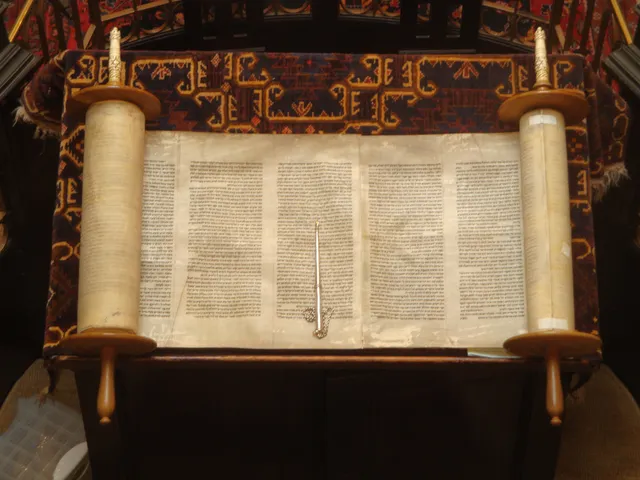
The fighting that follows is bloody, and honest readers feel it. Thousands die. The text records it without celebration and takes pains to note, three times, that the Jews did not touch the plunder, distinguishing them from Saul, who did. This is self-defense under a decree that had already authorized their slaughter, not a crusade. Scripture reports the violence of this world plainly rather than tidying it, and the book ends not with conquest but with a festival, Purim, named for the lots Haman threw. Every year since, Jewish families have read this scroll aloud and made noise at Haman's name, remembering that the dice an enemy rolled landed in God's hand.
Where the Silence Leaves Us
Most of us will never face a day like Esther's third day of fasting. But almost all of us live in the kind of world her book describes: one where God's name does not come up at work, where outcomes seem to turn on who is in the room and who had a bad night's sleep, where faith has to be practiced without a pillar of fire overhead.
Esther is the Bible's gift to that experience. It says that the God who split the sea also works through a sleepless king and a bureaucrat's filing habits. It says that the position you did not ask for, the city you did not choose, the table you were seated at by circumstances you resent, may be exactly the place where you are needed. And it says that this does not happen automatically. Someone has to walk into the room.
So the question Mordecai asked is still a live one. Not "what great thing has God called you to," but something smaller and harder: what is the room you have access to that others do not, and what would it cost you to speak there? Courage is usually not a feeling but a decision made in advance, before you know how it ends. Esther decided while she was still afraid, with no promise of survival and no voice from heaven, and the deliverance of a whole people came through a door she was not sure she would walk back out of.
If you are waiting for certainty before you act, this book will not give it to you. What it offers instead is a pattern: fast, then go. Count the cost, name it out loud, and go anyway. The One whose name the book never mentions is not absent from it, and He is not absent from your ordinary week either, moving in coincidences you may only recognize years later, asking whether you have come to this place, this role, this friendship, this difficult table, for such a time as this.