A woman I know drives forty minutes every Tuesday to a memory care unit outside Dayton. Her mother no longer knows her name. She sometimes calls her "the nice girl from the office," which is strange, because her mother never worked in an office. The visits are hard in the particular way that only this kind of loss is hard: there is a body in the chair, warm and breathing, and the person who taught you to tie your shoes is somewhere behind the eyes, mostly unreachable.
But here is the part that undoes her every time. Around four in the afternoon, the staff puts on music in the common room. And when the first bars of "Great Is Thy Faithfulness" come through the speaker, her mother, who cannot say what she ate for lunch, sings every word of all three verses. Morning by morning new mercies I see. She sings it the way she sang it in a Baptist church in 1961, with her chin lifted slightly, and then the Song of Songs ends and she goes quiet again and asks the nice girl from the office if she's seen her mother anywhere.
Dementia raises questions that polite theology usually gets to avoid. If a person loses her memories, has she lost herself? If she cannot pray, is she still praying? If she cannot remember that God exists, does any of it still hold? These are not abstract questions for the roughly fifty-five million people worldwide living with dementia, or for the far greater number of spouses, children, and friends who sit beside them.
Who Are You When You Cannot Remember Your Own Name?
Our culture answers the identity question with a fairly narrow definition of personhood. You are your mind. You are your choices, your productivity, your ability to narrate yourself. Lose the narration and you have lost, in some sense, the person. People say it out loud without noticing how cruel it is: "That's not really my father anymore." "She's already gone."
Scripture does not build a person that way. The first thing said about human beings is not that they think but that they are made, "in the image of God he created him" (Genesis 1:27), and that image is not a mental capacity that can be surgically removed by plaque and tangles in the brain. It is a status conferred by the Maker. An infant who has no memories at all bears it fully. So does a man of eighty-nine who has forgotten the names of all four of his children. Dignity in the Bible is given, not achieved, which means it cannot be unachieved either.
There is something else worth noticing. Psalms 139 is the great Psalms of being known, and look at the direction the knowing runs. "O Lord, you have searched me and known me." "You formed my inward parts." "In your book were written, every one of them, the days that were formed for me" (Psalms 139:1, 13, 16). Every verb belongs to God. David is not the one holding the file. God is.
That reversal is the whole comfort. Your mother's identity was never stored primarily in her hippocampus. It was and is held in the mind of God, who does not develop lesions. The record of who she is, every kindness, every hymn sung, every meal cooked at six o'clock for thirty years, is intact somewhere far more secure than her neurons. She is losing her grip on her life. God has not loosened his.
The God Who Remembers
When the Bible says God remembers, it almost never means that something slipped his mind and then came back. Biblical remembering is not recall. It is action taken on the basis of covenant.
"God remembered Noah" (Genesis 8:1), and the waters receded. "God heard their groaning, and God remembered his covenant with Abraham" (Exodus 2:24), and the Exodus began. God remembered Hannah, and Samuel was born. In each case remembering is the hinge where God turns toward someone and does something. It is the opposite of neglect.
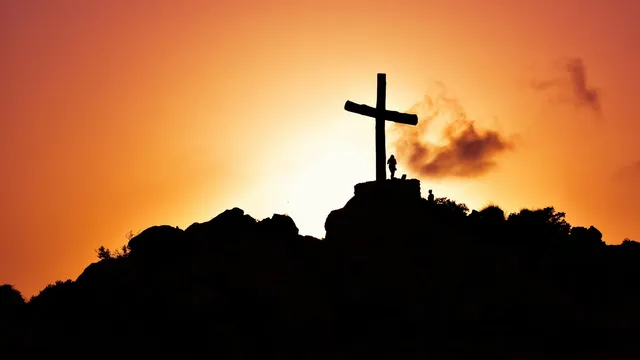
The most relevant scene for a family touched by dementia might be the one on the hill outside Jerusalem. A dying criminal, with no theology, no church membership, no capacity to do anything at all with his hands or his future, manages seven words: "Jesus, remember me when you come into your kingdom" (Luke 23:42). He is not asking Jesus to recall a fact. He is asking to be held. And the answer comes back immediately, without conditions: "today you will be with me in paradise."
If that is the standard, then the man in the recliner who can no longer finish a sentence is in no danger. His salvation never depended on the strength of his recollection. "If we are faithless, he remains faithful, for he cannot deny himself" (2 Timothy 2:13). Paul's list of things that cannot separate us from the love of God in Christ includes death, angels, rulers, height, depth, and "anything else in all creation" (Romans 8:38-39). Alzheimer's is in all creation. It did not make the exception list.
And there is a tenderness in how God holds the frail that should be read slowly by anyone changing an adult diaper at two in the morning: "he knows our frame; he remembers that we are dust" (Psalms 103:14). God is not disappointed by decline. He was never operating under the illusion that we were durable.
What the Body Still Knows
Dementia does not erase a person evenly. It takes recent memory first and works backward, and it tends to leave certain deep things remarkably intact: music, rhythm, prayer learned by heart, the smell of a kitchen, the feel of a hand. Caregivers discover this by accident. A father who cannot name his wife of fifty years will nevertheless say "and lead us not into temptation" the instant someone else begins "Our Father, who art in heaven."
This is partly neurology. Musical and procedural memory live in different, more protected regions of the brain. But it is also an argument for something the church has always done and lately half abandoned. When the psalmist says "I have stored up your word in my heart" (Psalms 119:11), he is describing a deposit, something put away now for a day you cannot foresee. The hymns you sing in your forties are the ones that will still be there in your eighties. The Twenty-Third Psalms memorized in a childhood Sunday school class comes back in a nursing home sixty years later, in order, without a prompt.
So sing to them. Read the Psalms out loud even when there is no visible response, because hearing is often the last door open and there is no evidence that nothing is getting through. Say the Lord's Prayer slowly and leave gaps. Bring the familiar translation, not the new one. If a pastor or elder can bring communion to the house, let them, because the body remembers the taking and the eating.
Faith does not live only in the part of us that can explain itself. Jesus was willing to work with the faith of people who could not produce it on their own. When four friends tore open a roof and lowered a paralyzed man down on a mat, the text says that Jesus "saw their faith" (Mark 2:5) and then spoke forgiveness over the man who had been carried. Some people get carried. That is not a lesser arrangement. That is the arrangement for all of us, eventually.
The Grief That Comes in Installments
Caregivers are often told they are saints, which is a well-meant sentence that makes it harder to admit the truth. The truth is that this is one of the loneliest griefs there is, because it arrives in pieces over years and never gets a funeral. You lose the conversations first. Then the shared jokes. Then recognition. Then continence, mobility, swallowing. Every stage is a death and none of them come with a casserole.
Exhaustion makes people do and feel things they are ashamed of. You snap at a woman who cannot help repeating the same question for the ninth time in an hour. You feel a flash of relief when she falls asleep, and then feel sick about the relief. You look at the calendar and catch yourself calculating, and then you cannot say out loud what you were calculating. Guilt lands on top of fatigue, which is like putting a stone on a man who is already underwater.
Scripture leaves ample room for this. A third of the Psalms are complaints. "How long, O Lord? Will you forget me forever?" (Psalms 13:1) is in the hymnbook of God's people, not in an appendix of regrettable thoughts. Jeremiah accuses God of deceiving him. Job says he will not restrain his mouth. The lament tradition exists precisely so that the faithful have somewhere to put the anger that comes with long suffering. You are allowed to tell God the truth about this.
Rest Is Not a Reward
When Elijah collapsed under the broom tree and asked to die, God's first response was not a rebuke or a sermon. It was sleep, and then food, and then more sleep, and then more food (1 Kings 19:5-7). The theology came later. The message was simple: the journey is too great for you.
Respite care is not a failure of love. Hiring help, using an adult day program, moving a parent into skilled nursing when the needs exceed what one body can give: none of these are abandonment. Honoring your father and mother (Exodus 20:12) means ensuring they are cared for well. It has never meant that you personally must do every task until you break. A caregiver who destroys her own health, marriage, and faith is not more obedient. She is just unavailable sooner.
When the Church Shows Up
Churches are generally good at crisis and bad at duration. Dementia is duration. The meals arrive during the diagnosis month and then stop, and the family enters year four with no one calling.
"Bear one another's burdens, and so fulfill the law of Christ" (Galatians 6:2) is not satisfied by a card. In practice it looks like someone sitting with Dad on a Thursday afternoon so his wife can get her teeth cleaned and cry in the car. It looks like a men's group putting grab bars in a bathroom. It looks like calling the daughter, not about her mother, but about her. It looks like refusing to let a family drift off the roster just because they can no longer make it to the eleven o'clock service.
And it means keeping the person with dementia inside the body of Christ rather than filing them under former members. Paul says the parts of the body "that seem to be weaker are indispensable" (1 Corinthians 12:22). That is a startling word: indispensable. Not tolerated, not pitied. A congregation that visits, sings, prays, and serves the Lord's Supper to its most forgetful members is being formed into something that the merely efficient version of church cannot produce. It is learning, in advance, how to love people who give nothing back.
Known, Even So
There is a question caregivers ask constantly, usually on the drive home: what is the point of visiting if she will not remember I came?
The answer is that the visit was never a deposit into her memory. It was an hour of her life, and during that hour she was not alone, and she felt something even if she could not file it. Emotional residue outlasts factual recall; people with advanced dementia routinely remain calmer for hours after a visit they cannot describe. More than that, the visit is a declaration, mostly to yourself and to God, about what kind of love this is. Love that requires a receipt was always something other than love.
Paul wrote to a church that prized knowledge and told them that for now, "we know in part," and that one day "I shall know fully, even as I have been fully known" (1 Corinthians 13:12). Read that with a memory care unit in mind. The promise is not that we will finally retrieve our lost files. It is that the knowing has been running in the other direction the entire time, uninterrupted, from a God who has never needed us to keep the record.
So sing the old hymn even if she only catches the last line. Say the Psalms she learned at seven. Hold the hand. And when you leave, say out loud in the parking lot the thing that is truest and hardest to feel: she is held, I am held, and the One who remembers is not forgetting any of this.