When Jesus spoke, the world tilted on its axis. His words weren't designed to fit neatly into anyone's categories - not the religious elite, not even His devoted disciples. The teachings of Christ turned assumptions inside out, revealing a Kingdom unlike anything the world had ever imagined. To follow Him meant to walk away from comfort, from convention, and often from one's natural sense of fairness. His words could heal the brokenhearted... but they could also unsettle even the most faithful followers.
The Upside-Down Kingdom
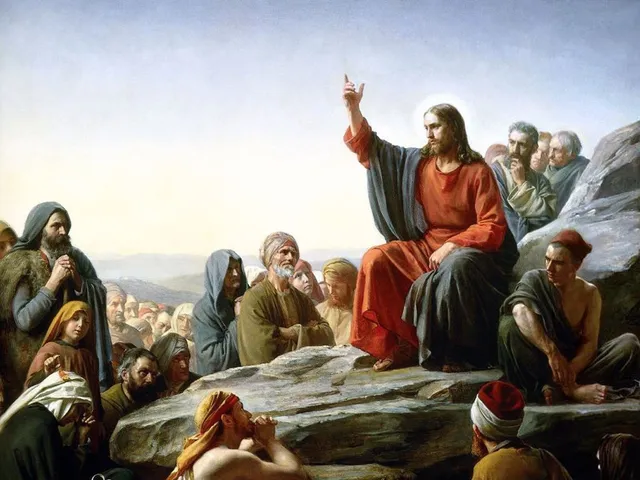
From His first sermon on a Galilean hillside, Jesus announced a Kingdom that flipped the world's values. "Blessed are the poor in spirit... blessed are those who mourn... blessed are the meek." (Matthew 5:3-5) These were not the qualities anyone expected of those who would inherit a Kingdom. Yet here was Jesus - declaring that humility, mercy, and purity would be the marks of heavenly greatness.
To the disciples, many of whom were young and zealous, still hoping that their Teacher would establish a political revolution, these words must have felt bewildering. They had dreamed of Messiah as a conqueror - a strong deliverer who would overthrow Rome and restore Israel's pride. But Jesus began with a declaration of weakness as strength, loss as gain, and surrender as victory. He was forming not an army of warriors, but a community of peacemakers.
"Love Your Enemies" - The Most Unthinkable Command
If there was one teaching that probably made every jaw drop, it was this: "Love your enemies and pray for those who persecute you." (Matthew 5:44) Even today, the words sting with impossibility. But imagine hearing them in a world shaped by vengeance, where justice was retribution and honor demanded retaliation.
For fishermen, tax collectors, and revolutionaries alike, this command cut against every instinct. The Romans had oppressed their people, collected unfair taxes, and crucified their neighbors. And yet, Jesus said love them. Not just tolerate, not even merely forgive - but love. He was calling His people to transcend hatred, not through denial, but through divine compassion.
The Heart of the Command
Jesus wasn't teaching weakness; He was revealing the nature of His Father. In loving enemies, the disciple reflects heaven's mercy - the kind that "causes His sun to rise on the evil and the good." This love is not possible without transformation. It can't be manufactured through willpower; it's birthed through encounter with God's relentless grace. That was the shock: Jesus demanded not improvement, but rebirth.
The Call to Radical Forgiveness
Peter once asked, almost incredulously, "Lord, how many times shall I forgive my brother... up to seven times?" (Matthew 18:21) Peter likely thought he was being generous. Seven times was plenty. But Jesus answered, "Not seven times, but seventy-seven times." He was redefining forgiveness as a lifestyle rather than a transaction. Forgiveness wasn't just a moral act - it was the heartbeat of the Kingdom.
When Jesus told the parable of the unforgiving servant soon after, He wasn't being theoretical. He was explaining what divine mercy looks like. The forgiven must become forgivers, and those who know grace must extend it. To withhold forgiveness was, in Jesus' view, to close one's heart to God Himself. His followers would have felt both cut to the core and liberated: this was hard truth coupled with healing truth.
"Take Up Your Cross" - The Call to Die
Few commands have provoked as much silence as the one where Jesus said, "Whoever wants to be My disciple must deny themselves and take up their cross daily and follow Me." (Luke 9:23) In the ancient world, the cross wasn't a metaphor. It was an instrument of execution. So when Jesus uttered those words, He wasn't speaking of mild inconvenience. He was inviting His followers to embrace a path of voluntary death - the death of self-preservation, pride, and personal ambition.
This was not an inspiring motto; it was breathtaking surrender. To take up one's cross was to accept shame in a culture obsessed with honor, to walk into loss while others chased gain. And yet, hidden in that call was the secret to true life: "Whoever wants to save their life will lose it, but whoever loses their life for Me will save it." (Luke 9:24) The cross became the paradoxical gateway to freedom, the hardest teaching that led to the deepest joy.
The Unlikely Heroes: The Last Will Be First
Again and again, Jesus dismantled people's assumptions about greatness. When the disciples argued over who among them was most important, Jesus sat down a little child in their midst. "Whoever welcomes one such child in My name welcomes Me." (Mark 9:37) The kingdom of God, He said, belongs to such as these.
To grown men shaped by a culture obsessed with status, this was disarming. Children, in their society, had no rank - they were powerless. Yet, Jesus not only blessed them; He made them the model for His Kingdom. The only way to enter heaven, He said, was to do so with a childlike heart - humble, trusting, without claim or credit. In one move, He made simplicity sacred and tore down the illusion of spiritual hierarchy.
The Power of Weakness
Jesus' idea of greatness stood in sacred contrast to the world's. The great ones of His Kingdom were not the most gifted but the most surrendered. Servanthood, not superiority, would become the crown of glory. On the night of His betrayal, Jesus embodied this by washing His disciples' feet. The act left them astonished. Peter even protested, unable to handle such reversal: the Master washing the servant? But that's how Jesus defined leadership - through humility wrapped in love.
Challenging the Religious Comfort Zone
Perhaps nothing shocked His followers - and especially the onlookers - more than Jesus' unflinching challenge to the religious system of His day. He said things no devout person thought He should say: forgiving sins directly, healing on the Sabbath, eating with tax collectors, speaking kindly to prostitutes. He shattered every line that separated the so-called "holy" from the "unclean."
He looked into the eyes of the condemned and offered mercy instead of stones. When they brought Him the woman caught in adultery, He exposed hypocrisy with a single sentence: "Let any one of you who is without sin be the first to throw a stone at her." (John 8:7) The silence that followed was the sound of hearts being undone.
Jesus wasn't soft on sin; He was fierce against the pride that distorted holiness. He wanted purity not of performance, but of heart. And His standard left no room for self-congratulation. "Unless your righteousness surpasses that of the scribes and Pharisees, you will never enter the Kingdom of Heaven." (Matthew 5:20) That must have been like thunder in the ears of His listeners. Who could surpass the righteousness of professional law-keepers? Exactly - no one without grace.
The Bread of Life and the Crisis of Faith
One of the most startling moments came after Jesus fed the five thousand. The crowd marveled - until He began to interpret the miracle. He turned to them and said, "Whoever eats My flesh and drinks My blood has eternal life." (John 6:54) His words were so mysterious, so offensive to religious sensibilities, that many followers walked away. This was too much. They wanted miracles, not metaphors of sacrifice.
But Jesus refused to soften His message. He was speaking of a spiritual participation in His life and death - union with Him at the deepest level. When others left, He turned to the Twelve and asked, "Do you also want to go away?" Peter answered with trembling honesty, "Lord, to whom shall we go? You have the words of eternal life." (John 6:68) Faith sometimes hangs on by a confession, not an explanation.
Grace Bigger Than We Imagine
Again and again, Jesus expanded the boundaries of grace. He praised the faith of a Roman centurion, saying it exceeded any He'd seen in Israel. He elevated a Samaritan - a cultural outsider - to hero status in one of His best-known parables. Each story pressed the disciples to widen their hearts beyond ethnic, religious, and national lines. The Kingdom was never meant to be tribal; it was meant to be transcendent.
This radical inclusiveness didn't come at the expense of truth, but as the fulfillment of it. In Jesus, righteousness and mercy embraced. Every shocking word, every boundary He crossed, revealed a larger mercy - one that would one day stretch its arms across a Roman cross, offering life to the very ones who drove the nails.
Living the Shock Today
It's easy to forget that the teachings that now feel familiar once rocked the world. But following Christ has never been about comfort. His words still disrupt our priorities today: love when it's costly, forgive when it's unreasonable, serve when it's unnoticed. That's where His Kingdom still turns ours upside down.
When we forgive those who wrong us, the world sees the Cross again. When we love our enemies, Jesus is visible in our response. When we welcome the overlooked, His heart lives among us. The same teachings that shocked the first disciples can still awaken our tired modern faith.
The Final Invitation
Every hard saying of Jesus carries an invitation underneath: "Come, follow Me." It's the call to trade self-rule for surrender, to choose grace over grievance, and to discover heaven's joy hidden in life's reversals. The disciples didn't just hear teachings - they walked with the Teacher. Each truth that startled them became a doorway into deeper intimacy with God Himself.
The words of Jesus still do that today. They shock us out of complacency, break our defenses, and lead us into freedom. The Gospel was never meant to soothe the comfortable but to set captives free. And in every paradox, we find the same promise: life that conquers death, love that heals hatred, and a Kingdom that cannot be shaken.
So let His words unsettle you again. Let them move you from hearing to following, from admiration to obedience. For the One who shocked His followers most is the same Lord who still transforms hearts today. And that, perhaps, is His greatest miracle of all.