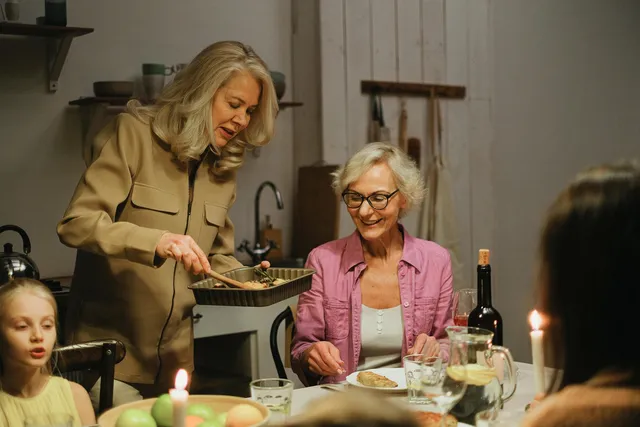
Three widows stand in the road somewhere between Moab and Judah, and the oldest one is trying to send the younger two home. It is not a tearful goodbye at a train station. It is a hard argument in the dust, with kissing and weeping and raised voices, because Naomi has decided that the kindest thing she can do for her sons' widows is to release them. "Go, return each of you to her mother's house," she says (Ruth 1:8). One woman takes her at her word. The other refuses, and her refusal becomes one of the most quoted vows in the Bible, spoken not to a husband but to a mother-in-law.
That detail alone should make us pay attention. Ruth 1:16, read at countless weddings, was originally a speech about in-laws. The relationship we joke about most is the one Scripture chose to make into a portrait of covenant love. And it did not sanitize the picture. Naomi is bitter. Ruth is a foreigner. There is no money, no man, no plan. Whatever this book teaches about family loyalty, it teaches it in the worst possible conditions, which is exactly why it is useful.
The Mother-in-Law Who Told Them to Go
Before we admire Ruth, we should notice Naomi. She has buried a husband and two sons in a foreign country. She has every practical reason to keep Ruth and Orpah close, because two able-bodied young women are the only security she has left. Instead she pushes them away, three times, with a blessing: "May the Lord deal kindly with you, as you have dealt with the dead and with me."
That is a rare kind of parent-in-law. She does not use grief as leverage. She does not say, "After everything I've lost, you would leave me too?" She names the truth that she has nothing to offer them and tells them to build lives she will not be part of. Naomi's first act of love is releasing her grip.
Many in-law conflicts begin exactly where Naomi refused to go. A mother who cannot stop parenting a married son. A father who keeps the financial strings attached so the advice stays welcome. A family that treats a marriage as a merger in which one side must be absorbed. Naomi models the opposite instinct, and she models it while she is at her weakest, which is when the temptation to hold on is strongest.
Loyalty That Costs Something
Ruth's answer is not sentimental. Read slowly, it is startling: "Where you go I will go, and where you lodge I will lodge. Your people shall be my people, and your God my God. Where you die I will die, and there will I be buried" (Ruth 1:16-17). She is renouncing her nation, her religion, and her prospects of remarriage among her own people, and she seals it with an oath invoking the Lord's judgment if she breaks it.
This is covenant language, the language of treaties and marriage vows, aimed at an older woman who had just told her she was free to leave. Ruth chooses obligation when she has been offered an exit. She does it for a woman who, within a few verses, will walk into Bethlehem and announce, "Call me Mara, for the Almighty has dealt very bitterly with me" (Ruth 1:20). Naomi says this standing next to the daughter-in-law who gave up everything for her, as though Ruth were not there. Grief can make people blind like that.
Ruth does not correct her. She just goes out the next morning and finds a field to glean in, which is the ancient equivalent of taking the hardest, lowest-paying job available so the household can eat. Loyalty in this book looks less like warm feelings and more like showing up at dawn. When Boaz finally meets her, what he has heard about is not her speech but her record: "All that you have done for your mother-in-law since the death of your husband has been fully told to me" (Ruth 2:11).
Orpah Is Not the Villain
It is worth pausing on the daughter-in-law who went home. Preachers have sometimes used Orpah as a foil, the one who lacked faith, but the text does not blame her. Naomi told her to go. She obeyed a legitimate release. She wept, kissed her mother-in-law, and returned to her mother's house to rebuild a life.
Not every family tie can or should be maintained at the same intensity. Distance, employment, a spouse's health, the demands of small children, and in some cases a history of real harm all shape what faithfulness can look like. Scripture honors Ruth's extraordinary choice without condemning Orpah's ordinary one. If you have been told that any limit you set with your in-laws is a betrayal, notice that the book itself does not say so.
Honoring People Who Are Hard to Live With
The fifth commandment says, "Honor your father and your mother" (Exodus 20:12), and while it is addressed to grown children about their own parents, the principle reaches further. Paul tells believers to "learn first to show godliness to their own household" and to care for aging relatives (1 Timothy 5:4). Marriage grafts you into a family you did not choose, with a history you did not witness, and honor is owed there too.
But honor is not the same as agreement, and it is not the same as obedience. Ruth honored Naomi by feeding her, staying with her, and treating her word as weighty. She did not honor her by pretending Naomi's bitterness was the final word about God. Honor means you refuse to speak of someone with contempt, you protect their dignity in front of your children, you take their counsel seriously, and you keep the relationship open. It does not mean you surrender your household's decisions to them.
That distinction matters most when the in-law is difficult. Some parents-in-law are critical, intrusive, or wounded in ways that spill out onto everyone nearby. Naomi, at her lowest, was not fun to live with. Ruth's response was neither confrontation nor resentment but steady, unglamorous kindness, the kind Paul describes as bearing "with one another in love" (Ephesians 4:2). Sometimes the most Christian thing available is to keep being useful to someone who is not currently able to thank you.
Leaving, Cleaving, and the Space Between
Genesis 2:24 sets the frame: "a man shall leave his father and his mother and hold fast to his wife." Jesus quotes it when He teaches on marriage (Matthew 19:5). Leaving is not abandonment; it is a reordering. A new household forms with its own center of gravity, and the old one has to make room. When that reordering never happens, in-law trouble follows almost automatically, because two families are competing to be primary.
Ruth and Naomi show what a healthy version of this looks like later in the book, and the details are easy to miss. Naomi gives Ruth a plan for approaching Boaz at the threshing floor, ending with the instruction, "he will tell you what to do" (Ruth 3:4). Ruth follows most of it. Then she departs from the script. Instead of waiting to be told, she speaks first: "Spread your wings over your servant, for you are a redeemer" (Ruth 3:9). She asks for marriage outright, and she names the legal obligation that makes it possible.
Ruth received her mother-in-law's wisdom without surrendering her own voice. She did not dismiss Naomi's counsel, and she did not follow it passively. Boaz's response is telling: he calls her a woman of noble character (Ruth 3:11). The initiative did not offend him. Any adult child or in-law who has felt trapped between honoring an elder and acting like a grown-up can find a model here.
Small Peacemaking, Repeated
Most generational conflict is not dramatic. It accumulates in comments about the grandchildren's bedtime, unsolicited opinions on money, a holiday schedule that always seems to bend one direction, a tone of voice at the dinner table that only one person in the room can hear. Paul's instruction is realistic about this: "If possible, so far as it depends on you, live peaceably with all" (Romans 12:18). Both qualifiers are doing work. Peace may not be possible. Your part is still your part.
Practically, that usually means a few unglamorous habits. Answer criticism with a soft response rather than a return volley, because "a soft answer turns away wrath" (Proverbs 15:1) is field-tested advice, not a platitude. Decide the big things privately as a couple before the family gathering, so no one is negotiating in front of an audience. Say the appreciative thing out loud, specifically, because in-laws often hear about their failures and rarely about the casserole, the airport pickup, or the fifteen years of birthday cards. Forgive quickly and repeatedly, "as the Lord has forgiven you" (Colossians 3:13), which assumes there will be plenty to forgive.
The Person in the Middle
Every in-law relationship has someone standing between two loyalties, and that person's job is the hardest. A husband who lets his mother criticize his wife in silence is not keeping the peace; he is outsourcing the cost of it. A wife who complains about her husband's parents to her own parents is building a coalition instead of a family. The middle person is called to be a translator and a shield: explaining each side to the other with charity, and absorbing the pressure rather than passing it through.
Interestingly, Ruth had no husband to mediate. She and Naomi had to make it work directly, without the man who had connected them. Many in-law relationships outlive the link that created them, through death or estrangement, and they can still be real. Naomi and Ruth stayed family when the legal reason to do so was buried in Moab.
When You Do Not Share a Faith
It is easy to forget that Ruth was the convert, not the born believer. She came from Moab, a people with a long and ugly history with Israel. She had every reason to consider Naomi's God unreliable, having watched that God's people bury three men in ten years. She chose Him anyway, and Boaz blesses her as one who has come "to take refuge" under the Lord's wings (Ruth 2:12).
Plenty of readers are in the reverse position: the believer married into a family that finds faith strange, or the parent whose child married someone who does not share the church. Scripture's counsel is consistent and quiet. Live in such a way that your conduct speaks before your words do (1 Peter 3:1-2). Refuse to make every gathering a debate. Let people watch you over years. The women of Bethlehem eventually said of Ruth that she was "more to you than seven sons" (Ruth 4:15), and no one got there through argument. They got there by watching a foreign woman feed an old woman for a long time.
The Harvest Nobody Expected
The last scene of the book is one of the tenderest in Scripture. Ruth marries Boaz and bears a son, and the neighbor women bring the baby to Naomi. She takes him and lays him on her lap. The woman who came home empty, who asked to be called Mara, is holding a grandson she has no biological claim to, born of a daughter-in-law she once tried to send away.
The child is Obed, father of Jesse, father of David. Matthew names Ruth in the genealogy of Jesus (Matthew 1:5), one of a handful of women listed, and a Moabite at that. The line that leads to Christ runs straight through an in-law relationship that nobody would have called promising. A grieving widow and a foreign daughter-in-law, arguing on a road, are three generations upstream from the throne of Israel.
That is not a promise that your family tension will resolve in a single lifetime. Naomi did not know what she was holding on her lap. What the story does say is that faithfulness in an ordinary, awkward, unresolved family relationship is never wasted, and that God has a habit of building things out of it that the people involved never see.
Start With the Field
If the whole picture feels out of reach, start where Ruth started, in a field at sunrise, doing the next useful thing. Not a grand reconciliation speech. Not a decision about how much you owe your husband's mother for the rest of your life. Just one act of service this month that costs you something small and asks for nothing back.
Call the father-in-law who never calls first. Ask your mother-in-law to tell you the story of her own wedding, and listen all the way to the end. Say one true, specific, generous sentence about your in-laws in front of your children, who are learning from you how to talk about family. Pray for them by name, which is remarkably difficult to do while nursing a grudge, and that difficulty is part of the point.
Naomi got a grandson she did not expect. Ruth got a home she had no right to. Neither of them planned it on that road out of Moab. They just kept walking in the same direction, and God met them at the harvest.