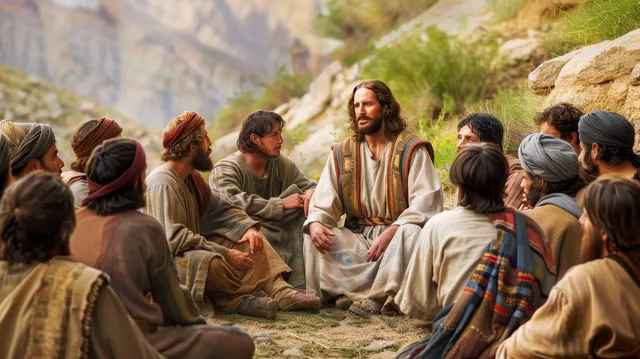
It is still dark in Capernaum. The night before, the whole town had crowded around a single doorway, carrying the sick and the tormented, and Jesus had healed them until late. By any reasonable measure, the next morning should have begun with more of the same. There were people still waiting. There was momentum. Instead, Mark tells us, "very early in the morning, while it was still dark, Jesus got up, left the house and went off to a solitary place, where he prayed" (Mark 1:35). When the disciples finally track him down, their words carry an edge of panic: "Everyone is looking for you!" His answer is not an apology. "Let us go somewhere else," he says, "so I can preach there also. That is why I have come."
Something in that scene refuses to leave me alone. The one person in human history who could have justified nonstop availability kept slipping away. Not once, under unusual strain, but as a habit. Luke makes it explicit: "But Jesus often withdrew to lonely places and prayed" (Luke 5:16). The word often is doing quiet, enormous work in that sentence.
A pattern, not a mood
Once you start watching for it, the withdrawals appear everywhere in the Gospels, and they cluster around the hinge moments of Jesus' life. Before he began his public work, the Spirit drove him into the wilderness for forty days (Matthew 4:1). Before he chose the Twelve, he "went out to a mountainside to pray, and spent the night praying to God" (Luke 6:12). After the feeding of the five thousand, when the crowd was ready to make him king by force, he dismissed everyone and went up the mountain alone (Matthew 14:23; John 6:15). When he heard that John the Baptist had been executed, he "withdrew by boat privately to a solitary place" (Matthew 14:13). On the last night, in a garden, he pulled away even from his closest friends to pray alone under the olive trees.
Notice the range of circumstances. Sometimes he withdrew because the pressure of popularity was distorting his mission. Sometimes because a decision was coming. Sometimes because he was grieving. Sometimes because he was exhausted, and sometimes because he was about to walk into the hardest hours of his life. The common factor is not the trigger but the response. Jesus' first instinct under both success and sorrow was to seek the Father in a quiet place.
That is worth sitting with, because our instincts usually run the other way. When something good happens, we broadcast. When something terrible happens, we distract. Jesus did neither. He went where there were no voices but one.
What he was doing out there
It is tempting to treat these retreats as recharging, the first century version of a long weekend. Rest was certainly part of it; Jesus had a body like ours and told his disciples plainly, "Come with me by yourselves to a quiet place and get some rest" (Mark 6:31). But the Gospels keep attaching the same verb to the solitude: he prayed. The quiet was not the point. The quiet cleared a space for a conversation.
And the content of that conversation seems to have been, at least in part, identity. At his baptism the voice from heaven said, "You are my Son, whom I love; with you I am well pleased" (Mark 1:11). Immediately afterward, in the wilderness, the tempter's opening move was to question exactly that: "If you are the Son of God." Jesus returned again and again to the place where the Father's word about him was clearer than the crowd's word about him. The crowds wanted a miracle dispenser. Herod wanted a curiosity. The religious leaders wanted a heretic they could pin down. His own family at one point wanted to take him home because they thought he had lost his mind (Mark 3:21). Everyone had a version of Jesus they were pushing. Solitude was where he refused to become the person other people needed him to be.
That is not withdrawal from love. It is the discipline that makes love possible. A man who has not heard from his Father is a man available to be shaped by whoever is loudest in the room. The Jesus who comes down the mountain is not detached from people; he is free for them. He can touch a leper without flinching and tell a rich young man the truth without softening it, because his sense of who he is did not come from the transaction.
The noise problem
We have a harder version of this challenge than Capernaum ever did, and we should be honest about it. Jesus had to walk away from a crowd that stayed behind when he left. Our crowd travels in our pocket. It wakes us up, rides with us, sits across from us at dinner, and waits beside the bed. The average person now touches a phone a few thousand times a day. Most of us cannot stand in a grocery line for ninety seconds without reaching for it.
The result is not simply that we are distracted. It is that we have lost the ability to be alone without being entertained, and with it, a certain kind of interior hearing. Elijah learned this the hard way on Mount Horeb. There was a great wind that tore the mountains apart, then an earthquake, then a fire, and the Lord was in none of them. Afterward came "a gentle whisper" (1 Kings 19:12). God is not obligated to compete with our noise, and he usually does not.
There is also a reason we keep the noise on, and it is not only habit. Silence is a mirror. When the stimulation stops, whatever we have been outrunning catches up: the grief we have not grieved, the conflict we have not addressed, the low hum of anxiety about money or a child or a diagnosis, the question of whether our life is adding up to anything. Blaise Pascal's famous line, that all of humanity's problems stem from our inability to sit quietly in a room alone, was not cynicism. It was diagnosis. We keep the radio on because the quiet asks questions.
Which means the discomfort of the first silent fifteen minutes is not evidence that silence is not for you. It is evidence that it is. The restlessness you feel in the quiet is not the obstacle to prayer; it is the first honest material of it. Psalms 62 puts it beautifully: "Truly my soul finds rest in God" (Psalms 62:1). The resting is something the soul learns, not something it does automatically.
Small portions, actually taken
Most of us hear "solitude and silence" and immediately picture a monastery, a week off, a cabin with no signal. Then we calculate that we cannot afford it, feel vaguely guilty, and move on. The better starting point is much smaller and much more stubborn: a handful of minutes you actually take, repeatedly, in the life you already have.
Start with the first five minutes of the day, before the phone. This single change does more than almost anything else, because whatever speaks to you first tends to frame everything after it. Sit on the edge of the bed. Do not plan the day. Do not produce anything. Say one short line and let it sit, something like "Here I am, Lord," or the line David prayed, "In the morning, Lord, you hear my voice" (Psalms 5:3). If your mind wanders forty times, return forty times. The returning is the prayer.
Then look for the gaps you are already given. The commute with the radio off. The ten minutes in the parking lot before you go in. The walk to the mailbox. The stretch after the kids are finally down. These are not spare moments; they are small deserts hidden in an ordinary week, and most of us hand every one of them to a screen without noticing. Reclaiming even two of them a day will do more for your interior life than an ambitious plan you abandon by Thursday.
Give it a place
Jesus had particular spots. Mark says he went to "a solitary place." John notes that Jesus often met with his disciples in a certain garden, which is how Judas knew where to find him (John 18:2). There is wisdom in having a chair, a step, a bench, a corner of the yard that your body associates with quiet. Habit is carried in the body more than in the will. Sit in the same chair at the same hour for three weeks and something in you begins to settle before you have said a word.
Let there be longer stretches, occasionally
Five minutes trains the reflex, but some things only surface with time. Once a month, take an hour. Once or twice a year, take half a day or a full one. No agenda, no podcast, no productivity. Bring a Bible and maybe a notebook, and expect the first forty minutes to feel like a waste. They are not. They are the layers coming off. The useful part almost always arrives after you have run out of things to say, which is precisely why the hurried version of this never works.
Silence with others, and silence that heals
Solitude does not have to be solo in the strictest sense. Families can practice it: a shared half hour on Sunday afternoon when the house goes quiet, nobody performing, nobody narrating. Couples can sit on a porch without filling the air. Some churches keep a few minutes of corporate silence before communion, and anyone who has experienced a roomful of people being quiet together knows it is a different thing entirely from being quiet alone. "The Lord is in his holy temple; let all the earth be silent before him" (Habakkuk 2:20).
One caution belongs here. Silence is not therapy, and it is not a substitute for care that some wounds require. If what surfaces in the quiet is persistent darkness, trauma, or despair, that is a reason to bring another human being into it, a pastor, a counselor, a friend who will sit with you. Even Jesus, in Gethsemane, asked three friends to stay nearby. Solitude is meant to be one rhythm in a life that also includes confession, community, and the table. It can be misused as a hiding place. The test is simple: real solitude sends you back toward people softer, not more superior.
He always came back down
That is finally what strikes me most about Jesus' withdrawals. Every single one of them ends with him returning. He comes off the mountain into a crowd, out of the wilderness into ministry, out of the boat into a mass of hungry people he has every reason to avoid. He never used the quiet as an exit. He used it as a source.
The point of going away is to come back different. The person who has spent twenty minutes in honest quiet is marginally less reactive at dinner, marginally slower to take offense in the group chat, marginally more capable of noticing the tired coworker in the elevator. Marginally is how most sanctification works. It accumulates.
So tomorrow, before the day has had a chance to tell you who you are, take five minutes. Let the phone stay face down. Sit still long enough to be uncomfortable, and then a little longer. You will not hear thunder. Most likely you will hear traffic, and your own noisy head, and underneath that, slowly, the old familiar word that was spoken over Jesus at the river and is spoken over everyone united to him: you are mine, and I love you. That word has been there the whole time. It just does not shout.