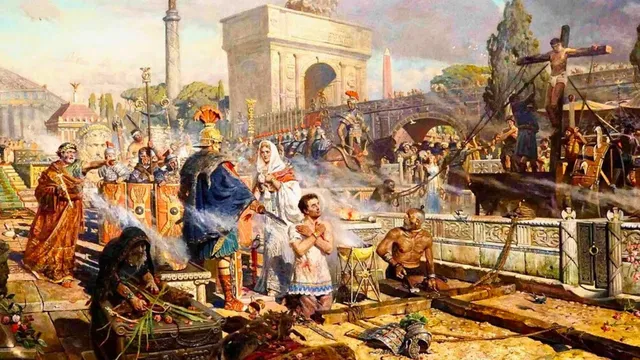
Rome was called the Eternal City. It was the axis of power, the throne of emperors, the pride of empire. Yet Scripture shows that what seemed eternal in stone and sword was destined to tremble before something unseen - the quiet, relentless advance of God's Kingdom. The meeting of Rome and the Bible is not just ancient history; it's a living parable about the collision between worldly greatness and divine grace.
The Power and the Promise
When Christ was born, Rome's empire had already wrapped the Mediterranean world in roads, laws, and legions. Caesar Augustus reigned, his name echoing in marble halls and public oaths. The Pax Romana promised peace - but it was peace through control, through victory, through the shadow of the sword. Into this imperial order came a baby in a manger, born to a young Jewish girl far from the marble of palaces. The promise of salvation did not arrive on Rome's golden chariots, but on straw and silence.
From the start, the story of Jesus stood in quiet opposition to everything Rome represented. Rome claimed lordship through might; Jesus claimed it through love. Rome built roads of conquest; Christ walked a road of humility that led to the cross. And yet, both worldviews sought to shape the hearts of men - one by fear, the other by faith.
When Empire Speaks to Scripture
Prophecy and Proclamation
God's prophets had long promised that the Messiah would come not to overthrow worldly powers as men expected, but to redeem hearts. Yet, ironically, Rome itself helped prepare the way. The empire's far-reaching infrastructure - its languages, its administrative order, its global reach - became the very channels for the gospel's spread. The Apostle Paul walked those Roman roads, carried a Roman name, and used his Roman citizenship to preach unhindered from city to city. What Rome built for empire, God repurposed for eternity.
God often turns the tools of earthly power into instruments of divine purpose. Just as He used Roman might to cradle the gospel, He turns our modern systems, technologies, and structures into avenues for His Word to reach hearts that would never have heard it otherwise.
Jesus Before Power
In the Gospels, one of the most haunting encounters occurs between Jesus and Pontius Pilate. The Roman governor stands as a symbol of worldly authority - anxious, political, pragmatic. When he asks Jesus, "Are you the King of the Jews?" the question drips with imperial suspicion. He is trying to measure a heavenly kingdom by the dimensions of an earthly empire. But Jesus answers with serene authority: "My kingdom is not of this world." (John 18:36)
That one statement unravels the pretensions of Rome and every empire since. Christ's reign does not rely on armies, decrees, or monuments - it rests on truth. And Pilate, the representative of the greatest power of the age, stands mute before a beaten man who is, in that moment, more sovereign than Caesar himself.
The Iron and the Clay
The prophet Daniel once saw an image of world empires as a great statue - gold, silver, bronze, iron, and clay - all shattered by a stone "cut without human hands" (Daniel 2:34). Rome was the iron. But even iron cracks when struck by divine purpose. When Jesus stood before Pilate, that prophecy was quietly being fulfilled: the empires of men were giving way to the Kingdom that cannot be shaken.
The Early Church and the Empire
After the resurrection, the followers of Christ carried His message into the heart of the empire. Within a generation, the gospel had reached Rome itself. But the clash between faith and empire did not fade - it deepened. The early believers refused to offer incense to Caesar, declaring that only Jesus was Lord. To the empire, it was treason. To the believers, it was testimony.
Martyrs like Peter and Paul transformed Rome's streets into holy ground. The same roads that once echoed with the tramp of legions now heard hymns sung in catacombs. The blood of the saints, Tertullian said, was the seed of the Church. And so it was: what began as a persecuted minority became an unstoppable movement, not because it conquered by force, but because it endured by faith.
Transformation from Within
When, centuries later, Constantine embraced Christianity, Rome's story seemed to turn full circle. The empire that had crucified Christ's followers now adopted His cross as its banner. History still debates the sincerity and consequences of that conversion, but one truth remains: no empire can remain unchanged after encountering Christ. The Word of God does not conform to pyramids of power - it remakes them from the inside.
Faith Amid the Ruins
Walk through the Forum today and you'll see Rome's columns rising like broken teeth against the sky. The empire that once claimed eternity has crumbled into dust and tour guides. Yet the words of Scripture, penned by persecuted believers within those very walls, continue to shape lives across continents. Where are Caesar's decrees now? Lost to time. But Paul's letter to the Romans - written from the heart of the empire - still speaks to the human soul as powerfully as ever.
The contrast is staggering: marble that claimed permanence lies in fragments, but parchment written in chains still changes eternity. God has a way of outlasting every empire.
What Rome Teaches the Modern Heart
We live in our own kind of empire - global, advanced, dazzling in its reach. Like Rome, our civilization prizes speed, structure, and success. Yet underneath the grandeur, souls still ache for meaning. The lesson of Rome and the Bible whispers across the centuries: power fades, but faith endures.
When we are tempted to trust in systems, wealth, or cultural might, the story of Rome calls us back to the quiet strength of God's Kingdom. The empire looked invincible in its age; so do many of the forces shaping our world today. But the Church does not stand because it is strong - it stands because Christ is risen.
Living as Citizens of Two Realms
Paul told the Philippians, "Our citizenship is in heaven" (Philippians 3:20). That single phrase guided countless believers living under Roman rule. It teaches us how to live under any empire - faithful to our earthly responsibilities, but loyal above all to Christ. We may walk Roman roads, use Roman tools, and dwell in Roman cities, but our hearts belong to another King.
To be Christian is to live paradoxically within power but not under it. We respect authority yet trust God's sovereignty; we participate in society yet keep our eyes on eternity. That balance demands courage - the kind the early Church embodied, and the kind we are called to reclaim today.
The Story Continues
Rome and the Bible is not just an ancient intersection - it's a living metaphor. When faith meets empire, heaven rewrites history. From the manger to the cross, from catacombs to cathedrals, from an empire's pride to its ruins, one message has rung clear: "The Kingdom of the world has become the Kingdom of our Lord and of His Christ." (Revelation 11:15)
We, too, stand at the meeting place of earthly kingdoms and heavenly truth. Every time we choose forgiveness over revenge, integrity over convenience, humility over ambition, we remind the watching world that Christ still reigns. We show that faith can flourish even in the shadow of power. Rome tried to stamp it out; instead, it became part of the story - a witness to the God who uses empires as footnotes to His glory.
The Enduring Kingdom
Empires rise and fall, but God's Word abides forever. The marble of Rome cracked, but the message Paul preached there has never lost its vitality. Today, whether we stand among skyscrapers or city ruins, the question remains the same Pilate asked long ago: "What is truth?" Christ answered with His life. The truth is that history bends toward redemption. And the Kingdom that began in a manger will one day cover the earth like light rising over ancient ruins.
Rome reminds us that no throne lasts forever - except the Lamb's. So lift your eyes, believer. The empire of Christ is not measured by walls or crowns, but by hearts reborn through grace. And that Kingdom, unlike all others, will never pass away.