Nehemiah, the sixteenth book of the Bible, tells how God uses a praying cupbearer to rebuild Jerusalem's walls and restore the community. With royal permission from Artaxerxes, Nehemiah surveys the ruins, rallies the people, and organizes the work despite mockery and plots from Sanballat, Tobiah, and Geshem.
After the wall is completed, Ezra reads the Law to the assembled people, who respond with repentance, covenant renewal, and joy. The book closes with reforms that guard worship, justice, and sabbath faithfulness.
Chapters of Nehemiah
What is Nehemiah about?
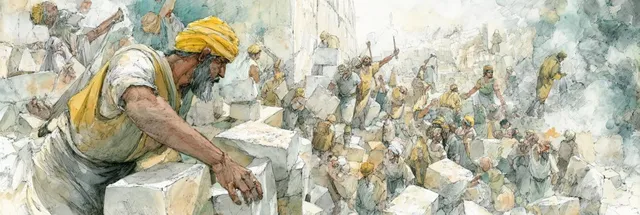
Nehemiah begins in the Persian citadel of Susa, where Nehemiah hears of Jerusalem's devastation and prays with confession and bold petition. Granted leave and letters by Artaxerxes, he inspects the walls by night and unites nobles and families to rebuild. Opposition comes in waves—mockery, threats, conspiracy—but Nehemiah counters with watchfulness, prayer, and wise leadership. Half the men work while half stand guard; builders carry tools in one hand and weapons in the other until the wall is finished in fifty-two days.
The focus then shifts from walls to hearts. Under Ezra and the Levites, the Law is read aloud and explained, the people weep and rejoice, and they celebrate Booths (Sukkot) for the first time since Joshua's days. A long prayer rehearses God's faithfulness and Israel's failures, leading to a written covenant that pledges support for the temple, sabbath observance, and separation from idolatry. The city is repopulated, the wall dedicated with choirs and thanksgiving, and Nehemiah's final chapter records reforms that confront mixed worship, economic injustice, neglect of the house of God, and profanation of the sabbath.
Who wrote Nehemiah?
Traditionally associated with Nehemiah's memoirs (first-person sections) compiled with lists and narratives—often linked to the Chronicler/Ezra tradition. Received as inspired Scripture across Jewish and Christian traditions.
What's Nehemiah's meaning and significance?
Nehemiah teaches that renewal requires both strong walls and formed hearts. God answers prayer, strengthens weary hands, and builds through watchful, courageous leadership. But the goal is not masonry alone; it is a covenant-shaped community that hears God's word, repents, rejoices, and practices justice and worship.
Is Nehemiah an important book?
Nehemiah is key for the theology of restoration, leadership, prayer, scripture, repentance, and community reform. It shows how God works through providence and human responsibility, uniting Ezra's teaching with Nehemiah's organizing to rebuild a people fit for God's presence.
When was Nehemiah written?
Events span the mid–late 5th century BCE (beginning in Artaxerxes I's reign); literary compilation finalized in the post-exilic era (5th–4th centuries BCE).
What are the main sections of Nehemiah?
Nehemiah moves from petition and permission, to rebuilding under pressure, to public scripture and covenant, and finally to dedication and ongoing reform—showing that lasting restoration is both structural and spiritual.
The main sections of Nehemiah are:
Key Elements of Nehemiah
Understanding the main themes, important people, significant places, and key concepts in Nehemiah helps us grasp its message and apply it to our lives today.
Key Themes
Key Concepts
Key People
Key Places
Chapters of Nehemiah
Select a chapter to read and study: